How to run a Heliox Consortium colony: how to start and how to save, how things are built — with blueprints, materials and a technician —, what each resource is, what each structure does and what goes inside it, what the corponauts do, what each gauge opens — the almanac, the staff, the log —, how to look at the sky, how to answer each alert, what each of the thirty asteroids has of its own, and what lies off that road: other kinds of ground and other corporations. The figures are those of the game at version 1.1.0.
HELIOX CONSORTIUM · NOTICE
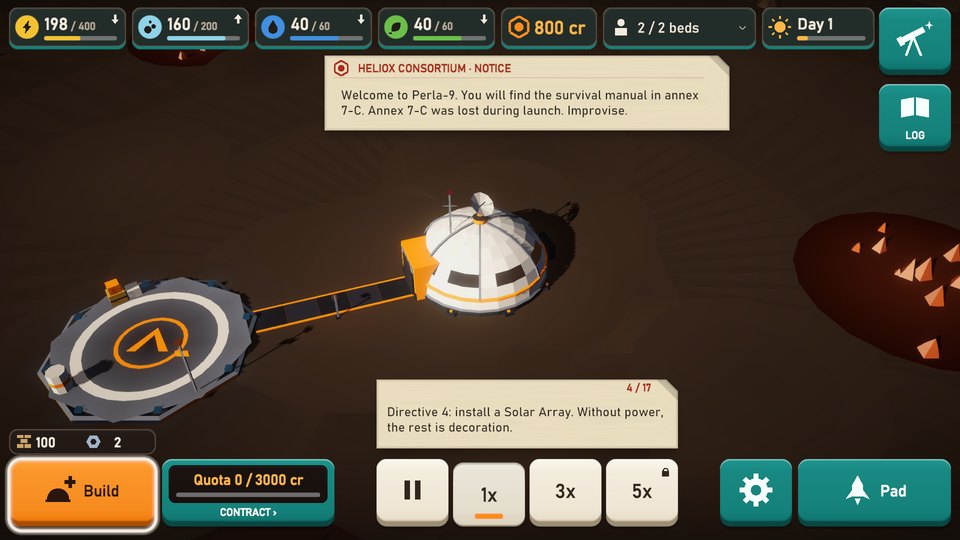
Welcome to Perla-9. You will find the survival manual in annex 7-C. Annex 7-C was lost during launch. Improvise.
Annex 7-C
01Opening the game
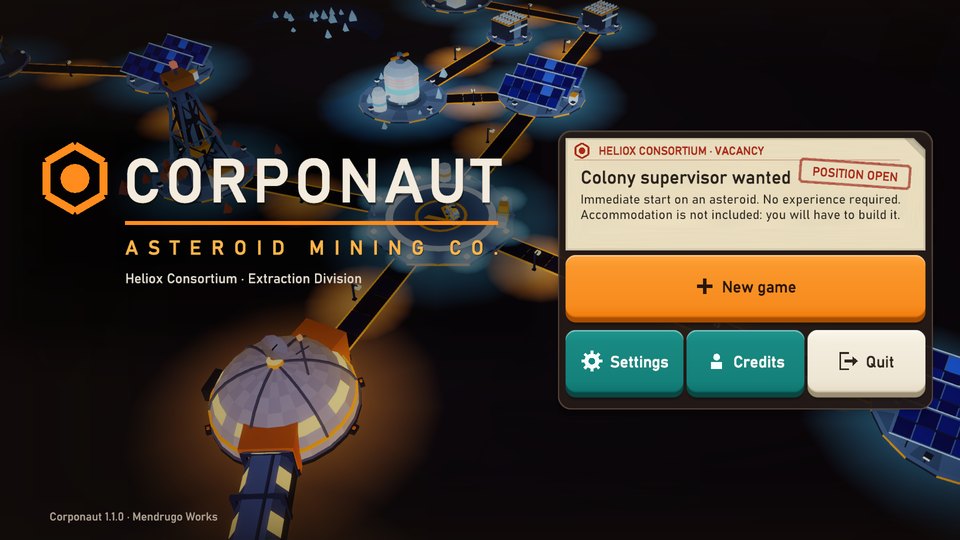
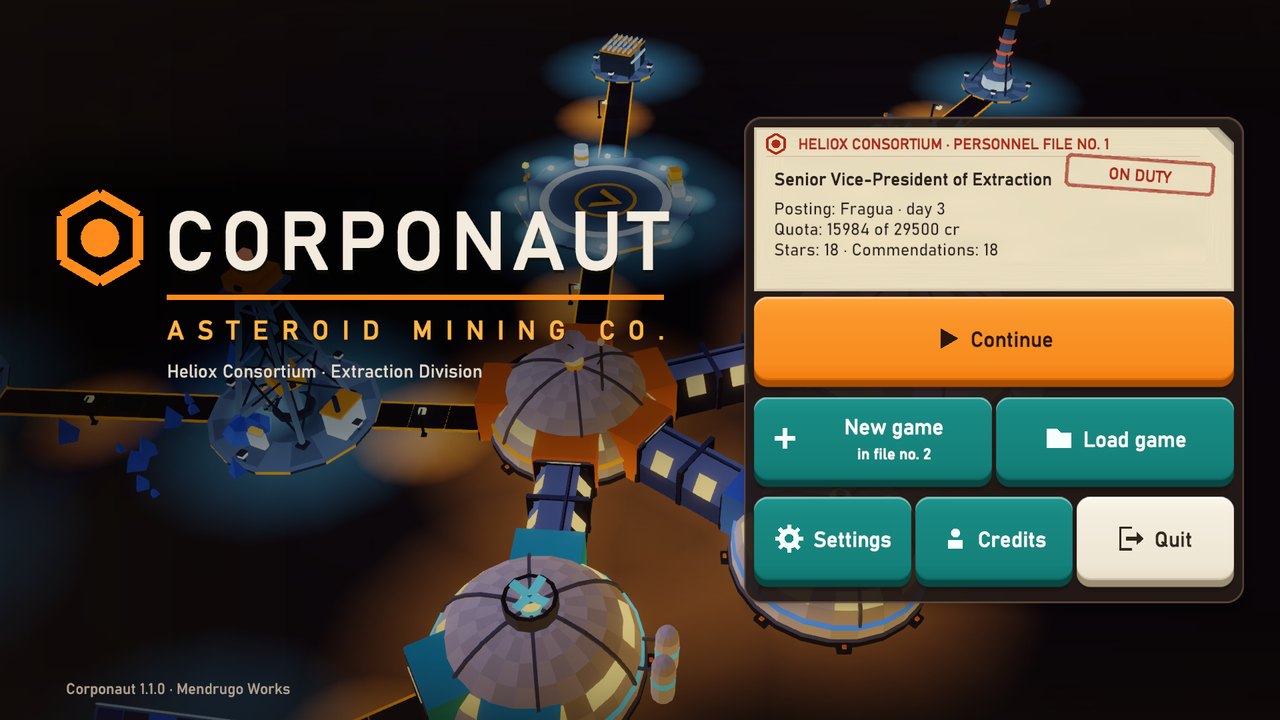
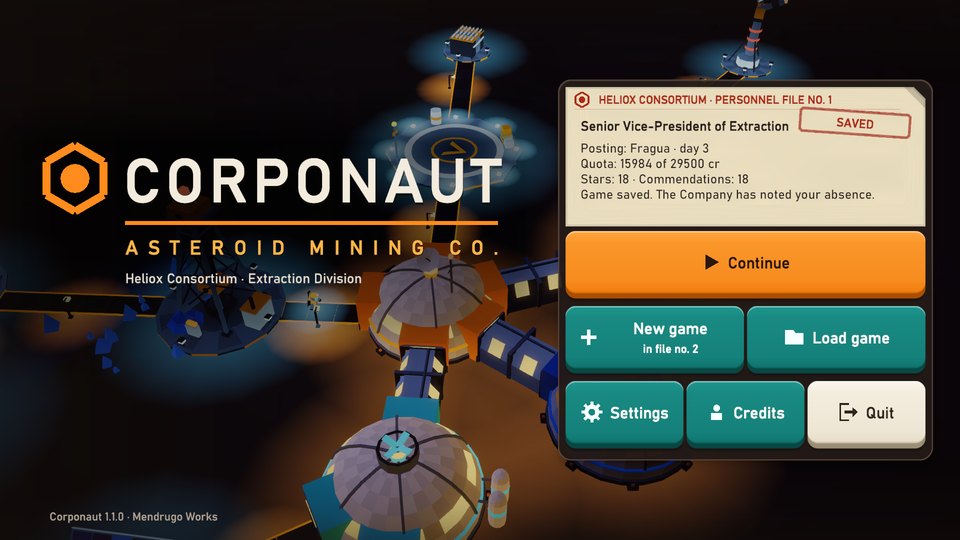
When the game opens, the studio's mark comes up, “MENDRUGO WORKS presents”: it lasts 2.4 seconds and a tap skips it. Then the title and the main menu. Behind them is your base, held still and turning slowly; if there is no saved game yet, a sample one.
The main menu, the first timeThe main menu, with a career under way
The main menu
A Company sheet and, under it, the keys. The first time, the sheet is a job advertisement — “Colony supervisor wanted” — and there are four keys. Once a game has been started, the sheet is your personnel file: rank, posting and day, quota, stars and commendations.
Key
What it does
Continue
Goes back to the game of the file on the sheet, where you left it. There is no loading screen: the base behind the menu is already that one. It is only there once there is a game.
New game
Starts a career in the first vacant file, and the key says which one before you press it. It never overwrites a game. The first time, it is the orange key.
Load game
Opens the files so you can choose another. It is only there once there is a game.
Settings
The six settings: they belong to the phone, not to one game.
Credits
Who made the game.
Quit
Closes the game.
The three files
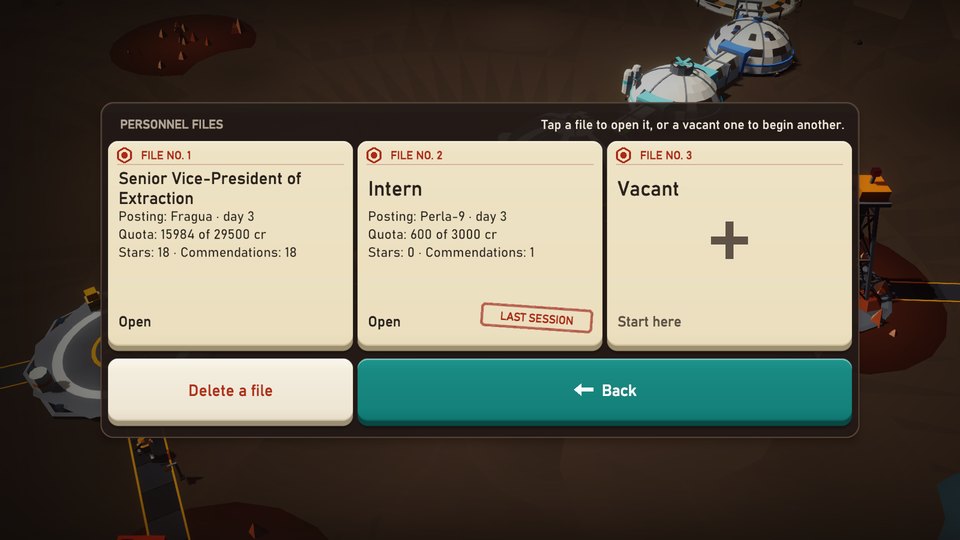
There are three personnel files, and each one is a whole career: its stars, its rank and the colony on every asteroid it has opened. They are there so that somebody else can play on the same phone, or so that you can start again without losing what you have done.
The three personnel files
Tapping a file in use opens it; tapping a vacant one starts a career there. The one played last carries the “LAST SESSION” stamp.
If none is vacant, New game starts nothing: it opens the files and says so. “There is no file free. Delete one to begin another.”
Delete a file asks for two taps on the card: the first arms it — it turns red, “Delete? Tap again” — and after three seconds it disarms by itself. All of it goes: career and colonies.
A file is a career, not a snapshot: there is no “save to another slot” and no way back to an earlier point. To do a contract again there is Restart contract, on the contract.
Save and exit
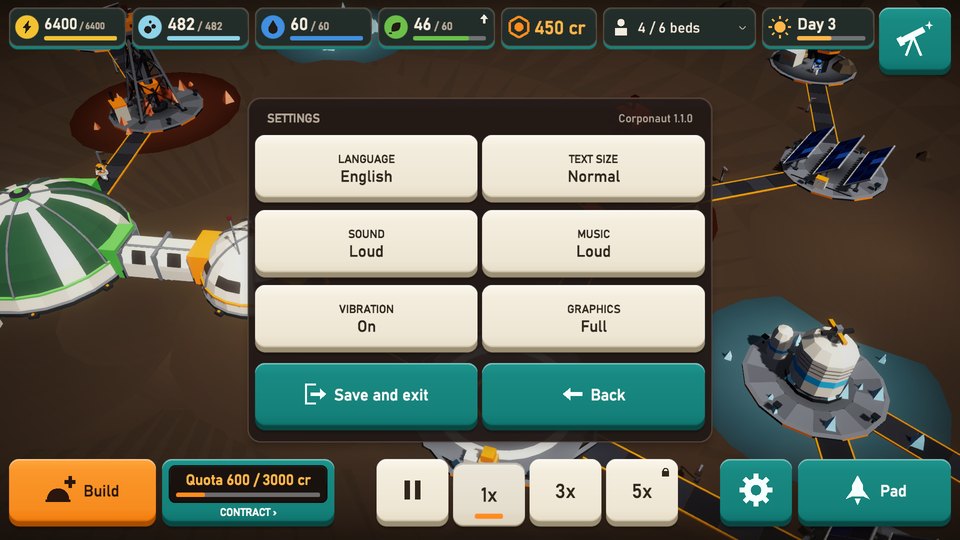
Save and exit is on the game's settings panel: the cog in the bottom row, or the Back key. It saves the game and returns to the menu, which confirms it with the “SAVED” stamp and a line: “Game saved. The Company has noted your absence.” One tap, no confirmation: nothing is lost.
Settings, inside a gameBack on the menu: “Saved”
You do not need it to keep your game: the game saves by itself every 60 seconds, when it goes to the background and when it closes (saving). It is the way back to the menu: to change file, or to quit.
On the menu, Android's Back key asks for two presses to close the game: “Press back again to quit”.
Anybody who was playing before there was a menu keeps their game: it is file no. 1.
02First things
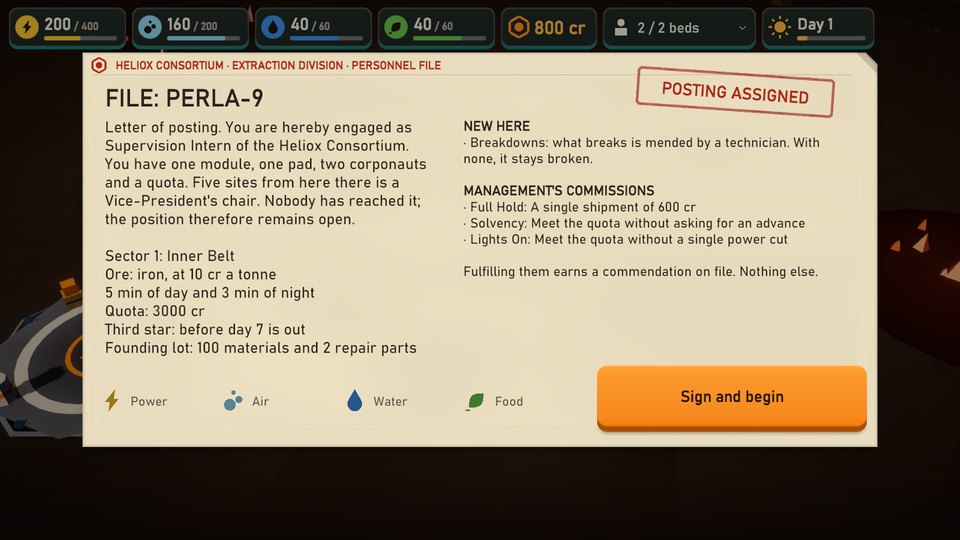
You supervise a mining colony for the Heliox Consortium. On arriving at an asteroid there is a Command Module, a Landing Pad, two corponauts (a miner and a technician), a founding lot, some credits and a quota. On Perla-9, the first: 100 materials and two repair parts, 800 cr and a quota of 3,000 cr.
The job is always the same: raise a base that keeps itself going, mine ore, invoice it at the Pad and reach the quota without anybody running out of air on the way. The Company no longer sells you the base: it sells you leave to build it. Money buys blueprints, the rock gives materials and the technician puts in the hands (building).
The file
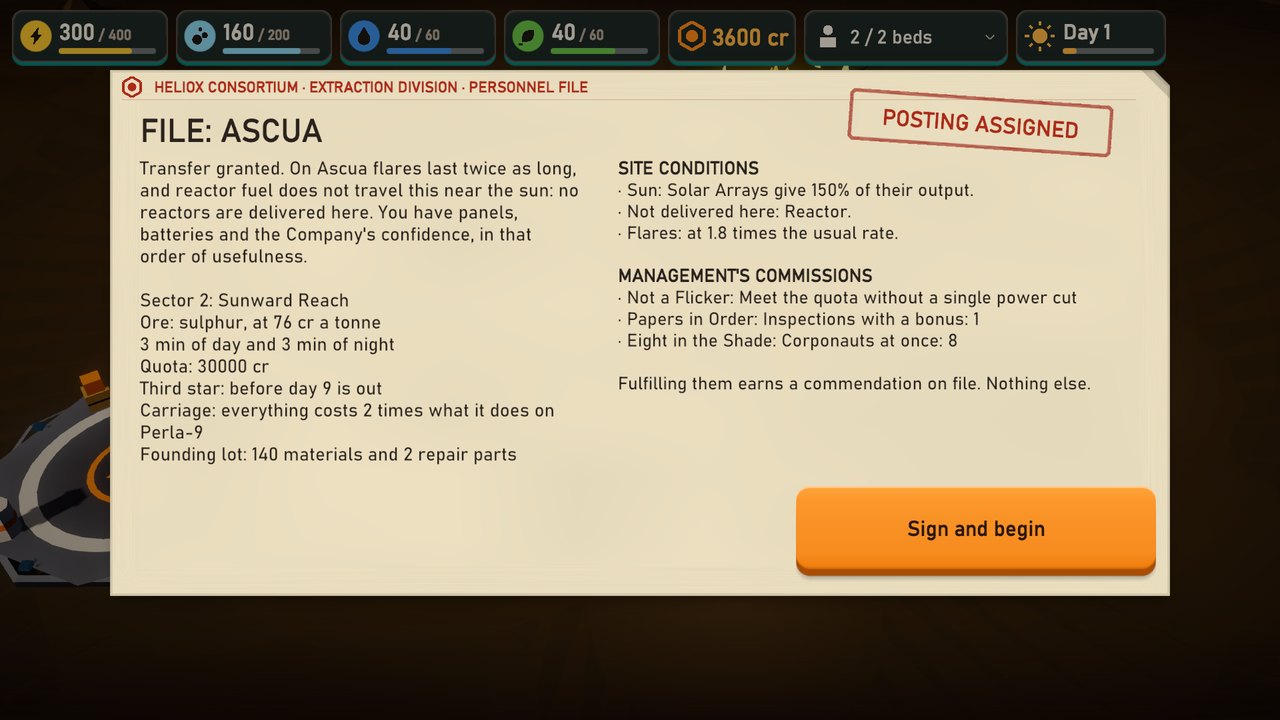
Before the clock starts, the Company puts the asteroid's file in front of you: the ore and its price, how long day and night last, the quota, the deadline for the third star, the founding lot — what you start building with —, what is new on that site and management's three commissions. While there is a paper to read, the clock waits. You sign it with Sign and begin.
The Perla-9 file
The seventeen Perla-9 directives
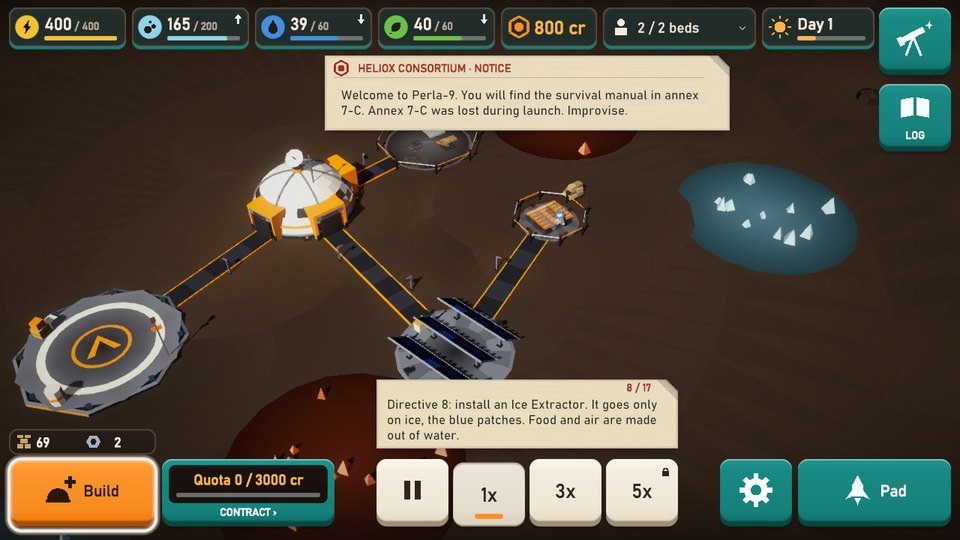
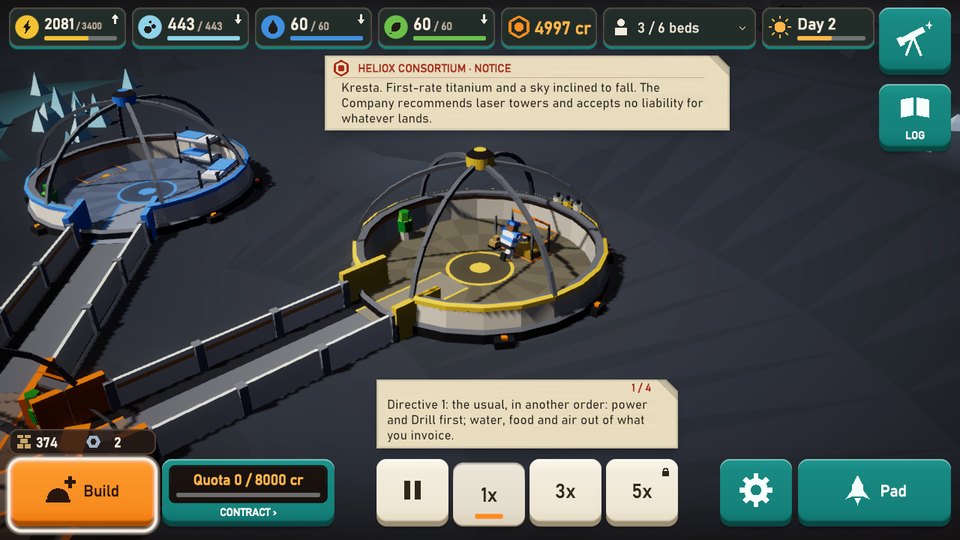
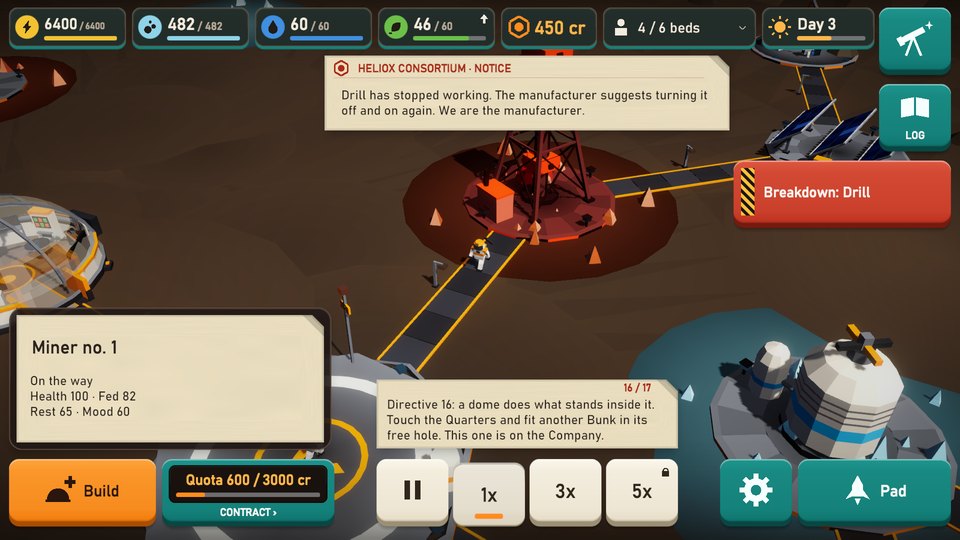
On the first asteroid the Company guides you with directives. Each one is given when the previous one is done and stays in view above the time keys, with its number (“4 / 17”); whatever you need to touch is marked with a pulsing frame. They do not block you: get ahead of them and they are skipped.
A directive: what it asks, its number and the key it points at
Drag a finger across the ground and look the site over. Looking is free.
Pinch with two fingers to move in or out. Turn them and everything turns.
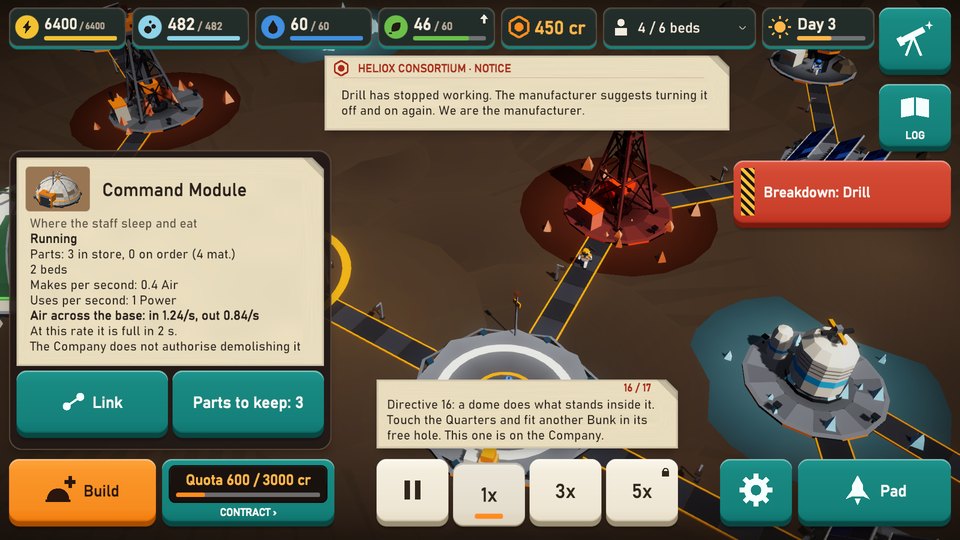
Touch the Command Module and read its card. Your staff sleep, eat and breathe in there. For now.
Install a Solar Array. Without power, the rest is decoration.
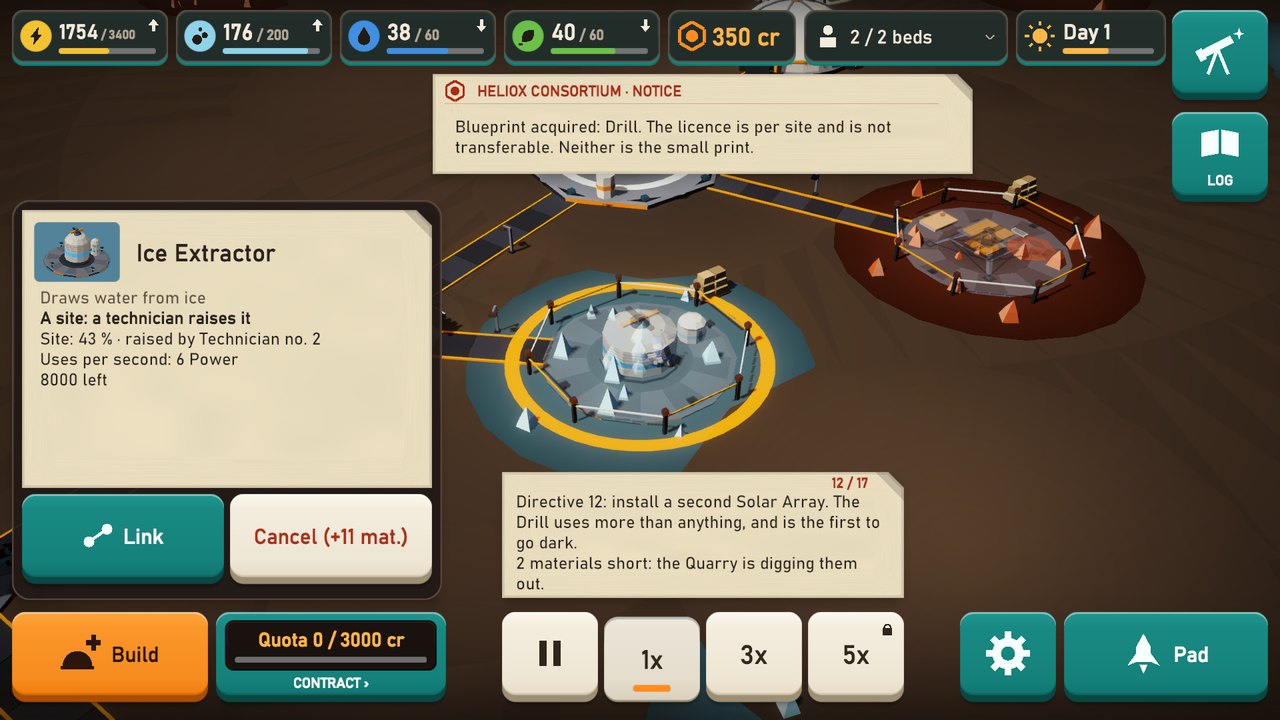
What you have put down is a site. Your technician will raise it: the Company supplies the plan and you, the hands.
Install a Battery. Night always comes, and it comes without panels.
Install a Quarry. Everything is raised with materials, and materials come out of the rock. The founding lot runs out.
Install an Ice Extractor. It goes only on ice, the blue patches. Food and air are made out of water.
Install a Greenhouse: it grows what is eaten in the Command Module. Unfed staff leave us permanently.
Install Life Support. It makes air out of water. Without air, staff last a minute. Then they do not.
They will live. Buy the Drill's blueprint in the catalogue and put it on a seam, the reddish patches.
Install a second Solar Array. The Drill uses more than anything, and is the first to go dark.
What breaks is mended with a part. Touch the Command Module and have it keep 3: your technician makes them from materials.
Once there is ore, open the Pad and call the freighter. Only what is invoiced counts.
Install Quarters: four beds. With no bed they sleep on the floor, rest badly and remember it.
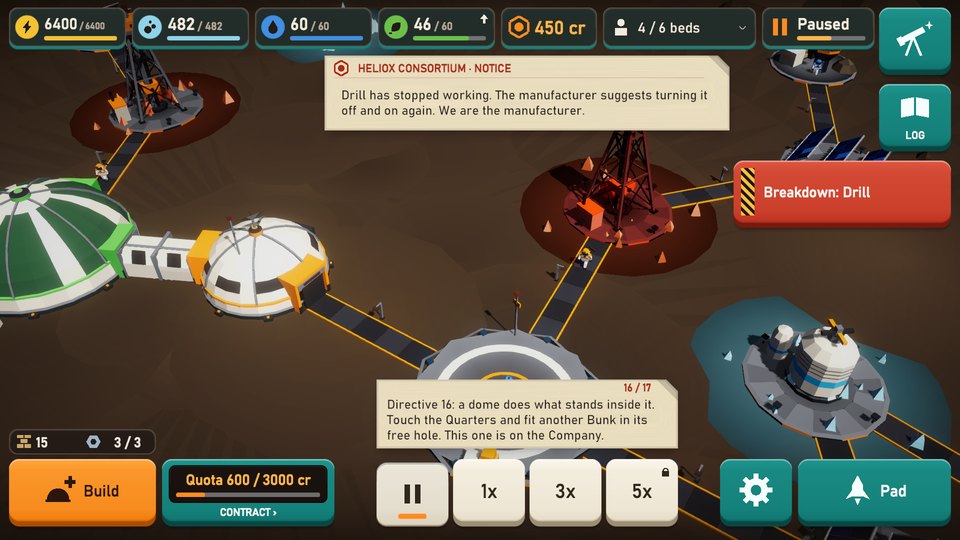
A dome does what stands inside it. Touch the Quarters and fit another Bunk in its free hole. This one is on the Company.
Request staff at the Pad. More hands, more quota; and more mouths, which you now know how to fill.
First you survive, then you invoice. That order shows you where the staff live — in the Command Module they sleep, eat and breathe — and puts in front of you what keeps them alive: power, a battery for the night, water, food and air. On the way it teaches how things are built: what you place is a site, and the technician raises it; everything is paid for in materials, and materials come out of the Quarry. Only then comes the Drill — its blueprint is the first money you spend — and more panels with it, because it uses the most and is the first thing to switch off. After that, how many repair parts to keep, the first shipment, beds, one more bunk inside the Quarters and more staff. On Perla-9 people eat in the Command Module; the Canteen comes with your first promotion.
If you are short of materials for what the directive asks, the strip says so underneath: “6 materials short: the Quarry is digging them out.” With no Quarry standing, it says none will come.
If it is credits you are short of — for a blueprint — it says that too: “180 cr short: shipments bring them.”
If the money runs out before there is a Drill, no shipment is going to bring any: the frame then points at the Pad and, inside it, the advance. “150 cr short and nothing bringing them in: ask for an advance at the Pad.”
Saving and leaving half-way through does no harm: when you come back the same directive is in force. Each file has its own.
Each of the other twenty-nine asteroids gives three or four directives of its own, about what changes there. They are under the thirty asteroids.
HELIOX CONSORTIUM · NOTICE
End of directives. From here on, the Company trusts you. Do not mention it.
03The screen
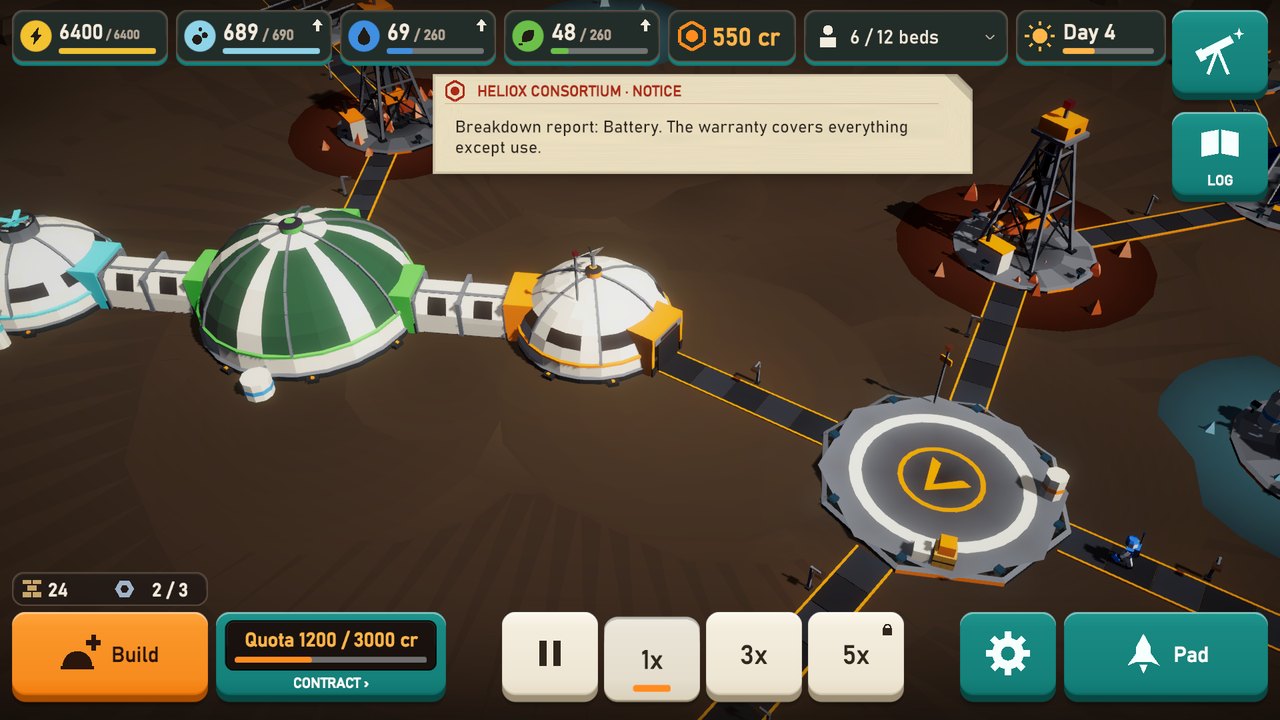
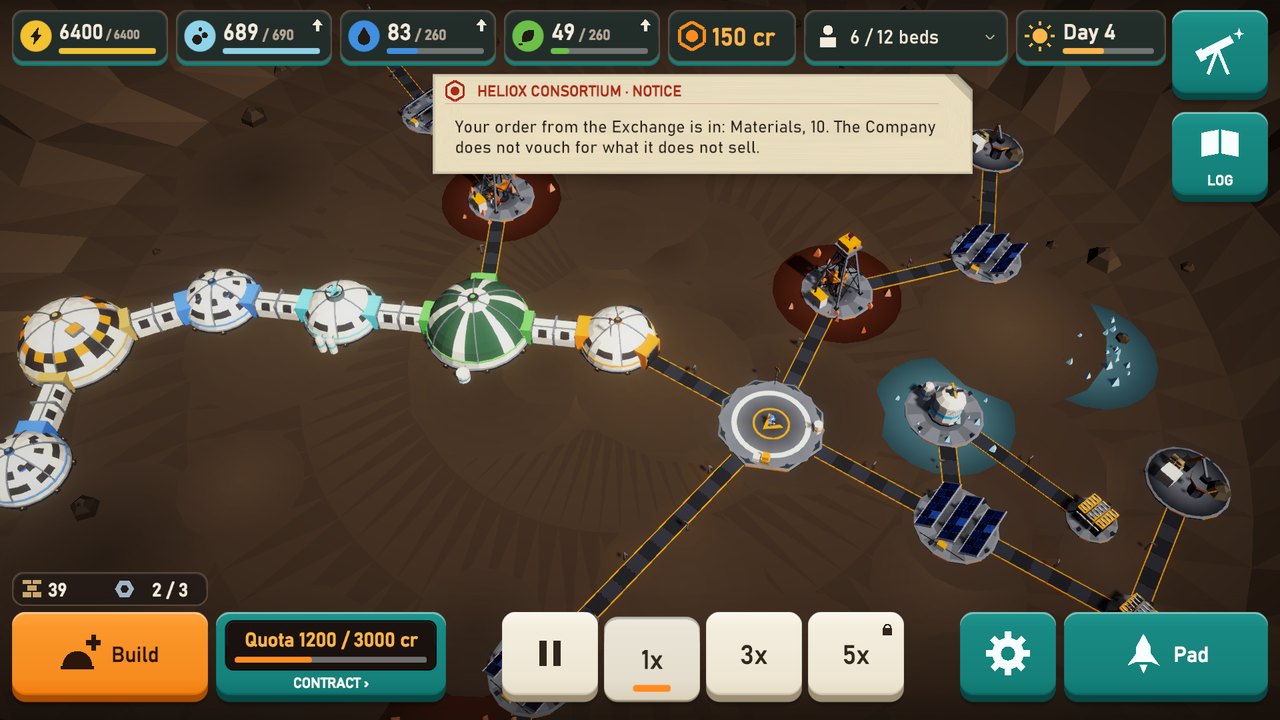
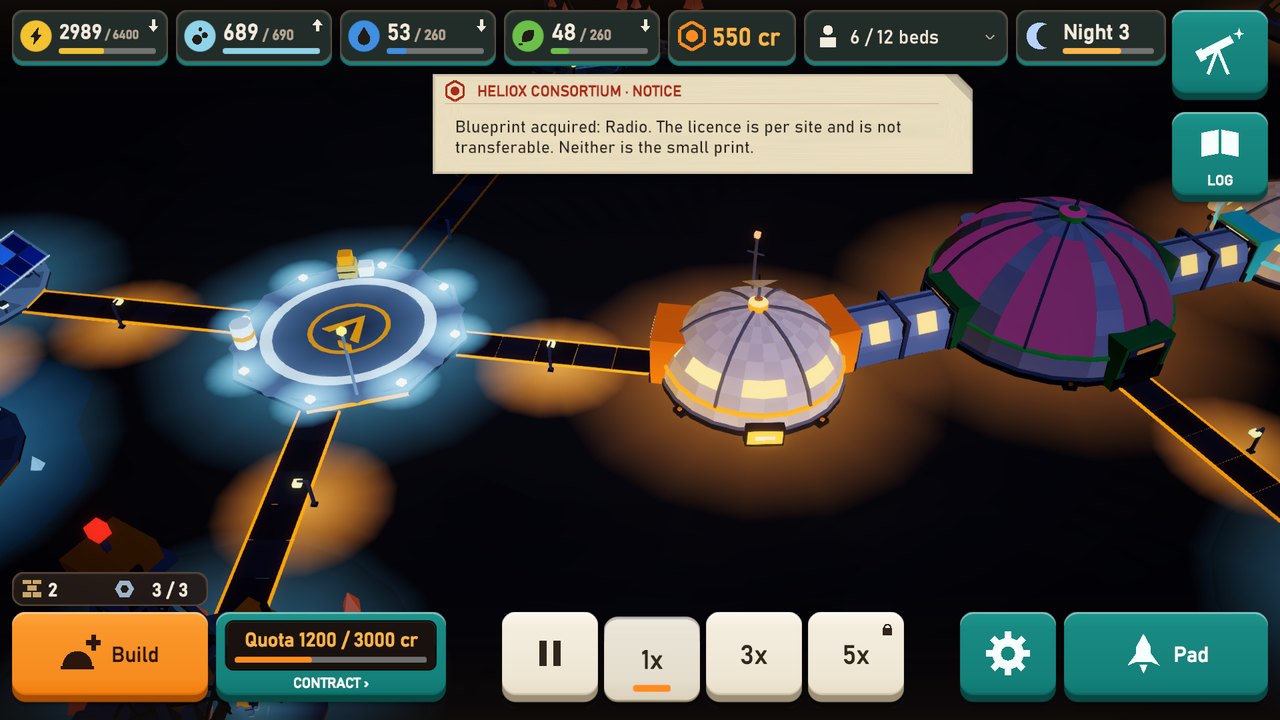
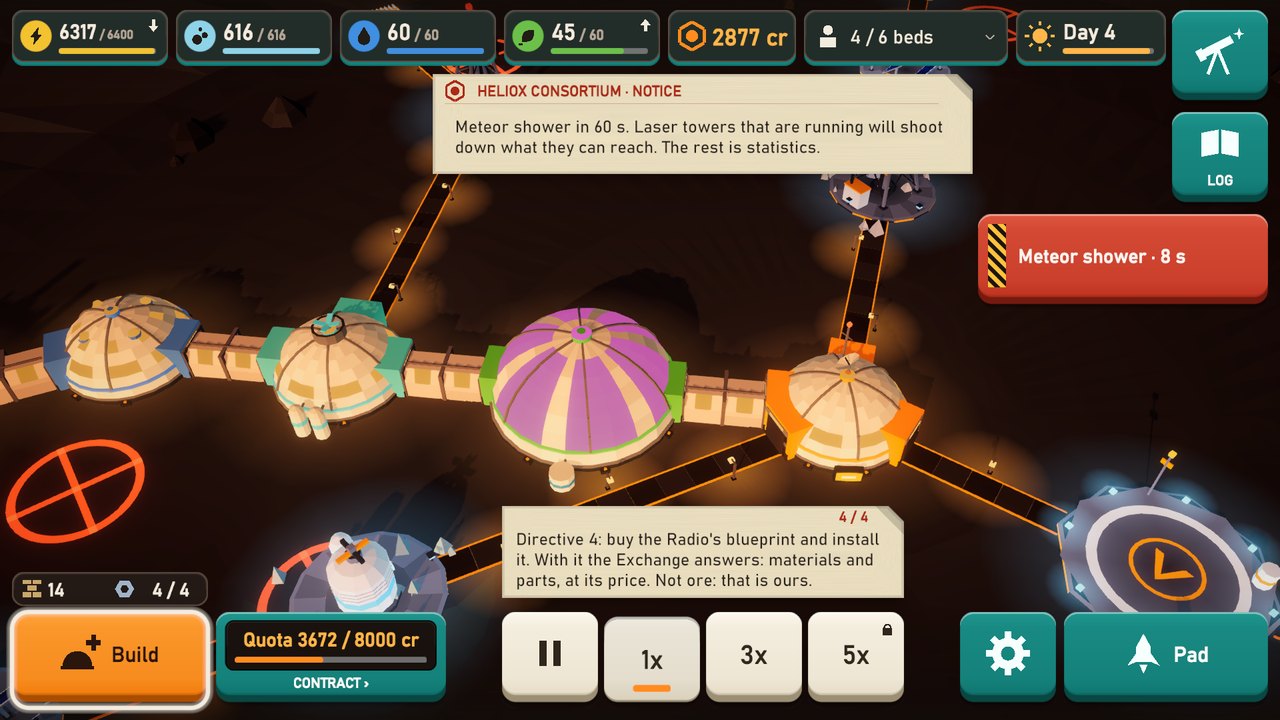
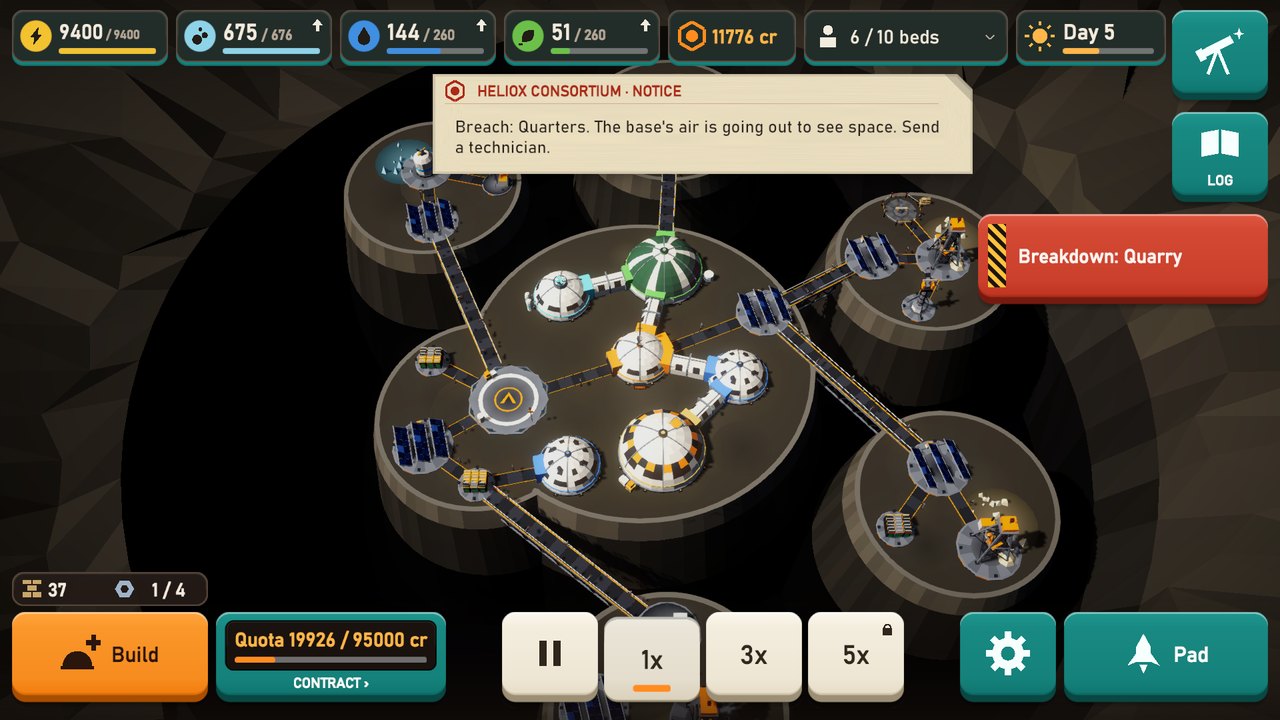
The screen: gauges on top, keys below, two keys in the corner, the materials strip and a notice
Along the top: information
These are gauges, and they are pressed: each one opens what it measures, and pressed again it closes it. The teal edge showing under each says so: teal is the colour of everything that opens a panel. While something is being placed, or with a Company paper waiting to be read, they only measure.
The four vitals — Power, Air, Water and Food: how much there is and how much fits, a bar, and an arrow if it is rising or falling. The bar turns the colour of the alert when it runs short. Pressed, it opens the almanac at that resource's sheet.
Credits: what is in this asteroid's account. It opens their sheet of the almanac.
Staff and beds: “4 / 6 beds” means four people and six beds. It carries the mark of something that opens downwards: pressed, it lets down the sheet of the staff by trade.
The day or the night, with a bar of how much is left. When paused it says so here: “Paused”. Pressed, it opens the mission log.
In the corner: the lookout and the log
At the top right there are two keys that are not the base's daily work. The spyglass takes the camera down to the lookout, to look at the sky. LOG, below it, opens the mission log. When a panel comes up as far as them they are put away, and they come back when it closes.
Along the bottom: what you press
The strip of materials and parts, above the build key: how many materials there are to raise things with and how many repair parts, with the standing order beside them once it has been given (“3 / 3”).
Build opens the catalogue.
The quota: what has been invoiced and what the contract asks (“Quota 1200 / 3000 cr”). Press it and it opens the contract.
Time: pause, 1x, 3x and 5x.
The cog: settings.
Pad: the freighter, staff and the advance.
On the right: alerts
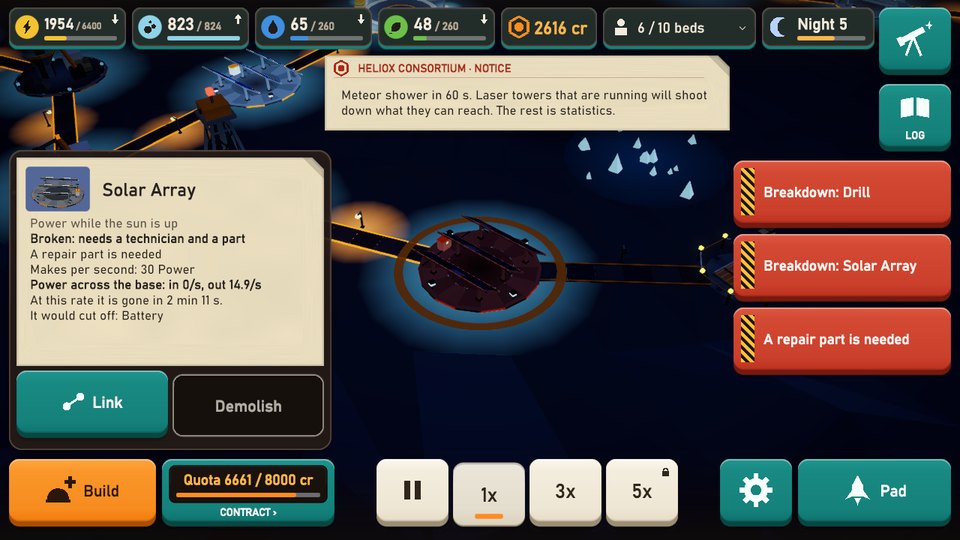
They are red keys with hazard stripes. At most three show, and the last one says how many more there are. Tapping one takes the camera to the problem. For anything announced that has not yet arrived they say how long is left: “Meteor shower · 42 s”.
The Company's papers
Notices arrive one at a time, at the top, on paper. All of them are kept on file: the quota key and then, on the contract, Notices.
The colour of a key says what it is for
Orange The main action on that screen. There is only one.
Teal Open a panel or go somewhere else.
Ivory Choose, toggle, cycle: time, staff posts, each setting.
Red Danger: alerts, and anything destructive once armed.
Anything destructive is ivory written in red and asks for two taps. A key that cannot be pressed right now is a dark hollow, and it says why.
04Looking and touching
One finger drags the ground, which stays under your finger.
Pinching moves in and out. The tilt goes with the zoom: up close you look more from the side; from far off, more from above.
Two fingers turning rotate the world with them.
A double tap on a structure centres it; on the ground, it centres that spot.
Zooming in never reaches the sky: the camera over the base always looks down. To see it there is the spyglass key, top right, which takes you to the lookout; there a finger does not drag the ground, it turns your gaze.
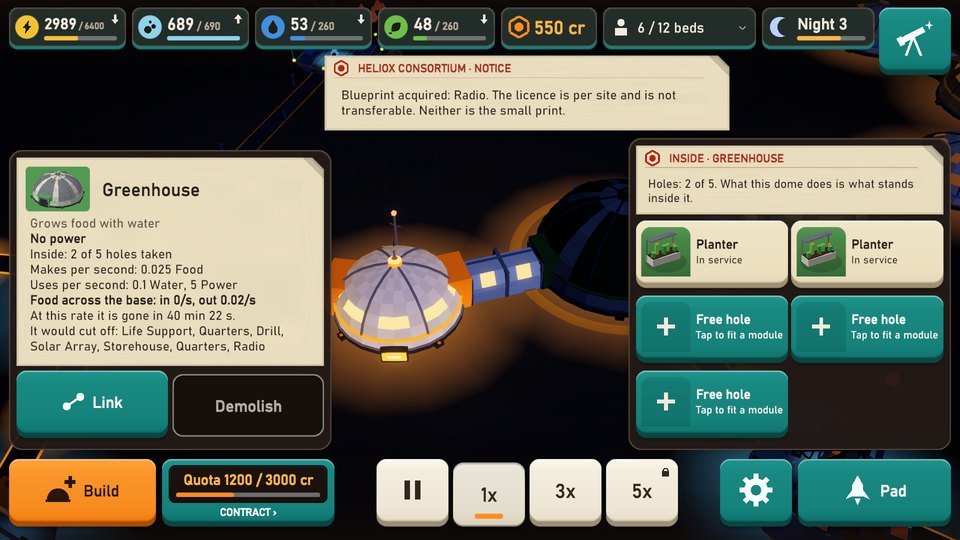
Tapping a structure opens its card: what it makes, what it uses and why it is not working. Linking and demolishing start there. Tapping empty ground closes it.
A corponaut can be tapped when outside, on a walkway or at a rig. Inside a dome, what you tap is the dome.
A slow tap is still a tap: up to 1 second with the finger held still.
A corponaut on the move is found by your finger where you see them, not where they were a moment ago.
Android's Back key closes whatever is open, nearest first. With nothing open, it opens the game's panel — the settings, where Save and exit is — and pressed again it closes it. It never takes you out of the game by accident: on the main menu it asks for two presses.
The phone answers in your hand: a light tick for each key, a different one when the game says yes or no, and a thump for what happens on the base. It can be turned off in Settings.
A structure's card
05Building: blueprints, materials and sites
Building takes three things, and each runs out for a different reason: a blueprint, bought with money once per contract; materials, which come out of the rock; and a technician, who is the one who raises what you place.
Everything is placed the same way, in five steps.
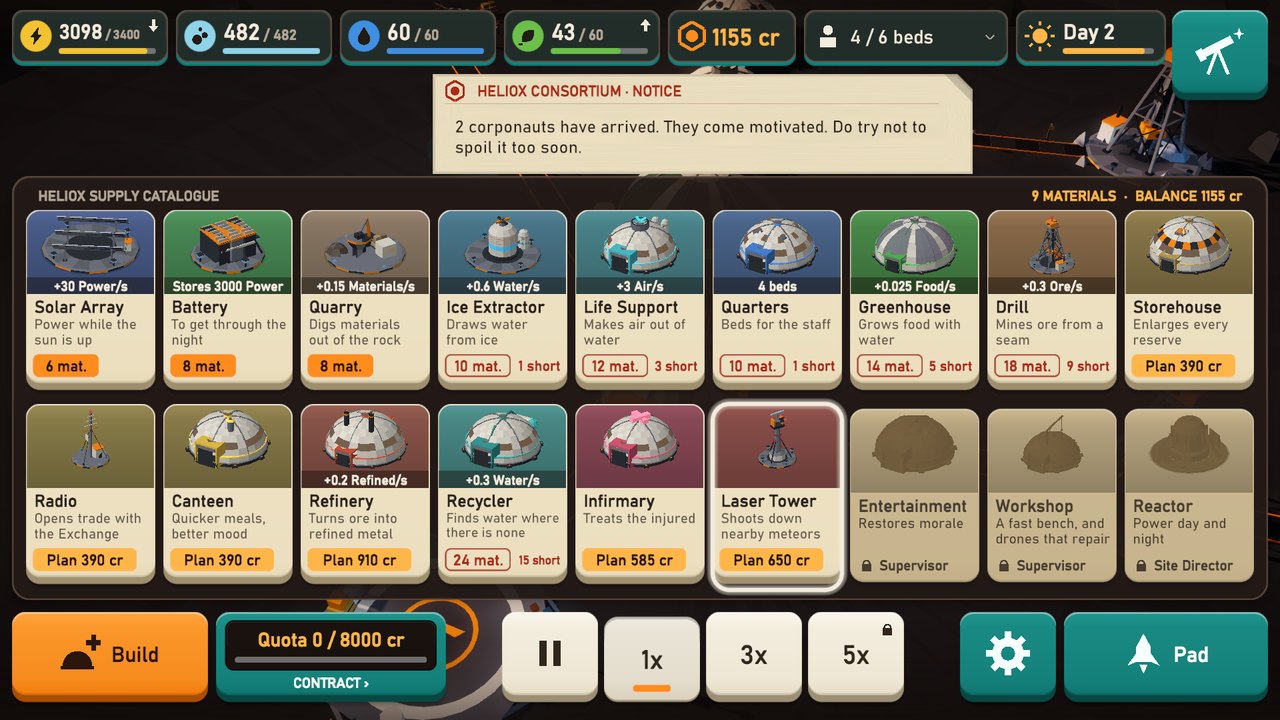
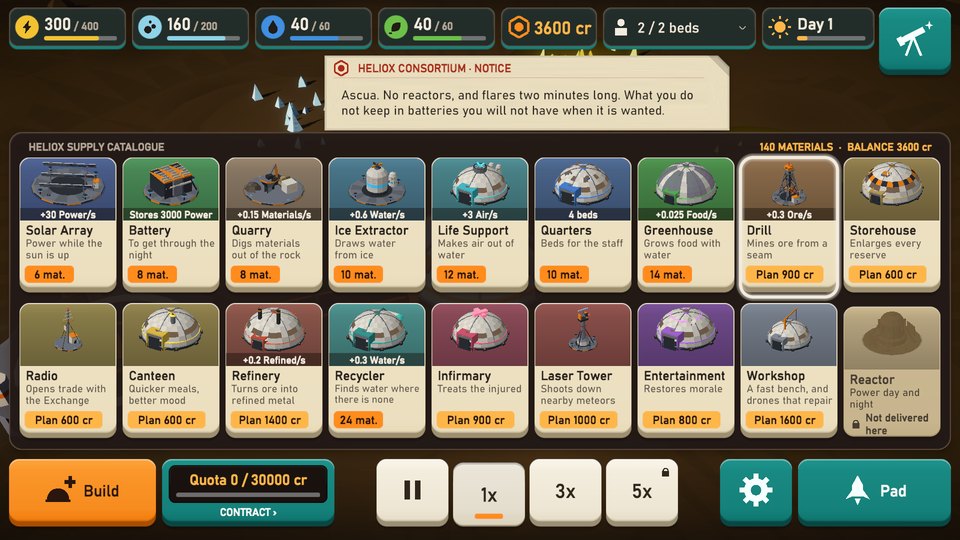
Build opens the Heliox supply catalogue. Each card shows the structure, what it is for, what it gives and a tag: “Plan 450 cr” if its blueprint is still to be bought, or what each unit costs in materials (“18 mat.”) once you hold it. If you cannot afford it, it says how much you are short; if your rank does not authorise it yet, it says which rank does.
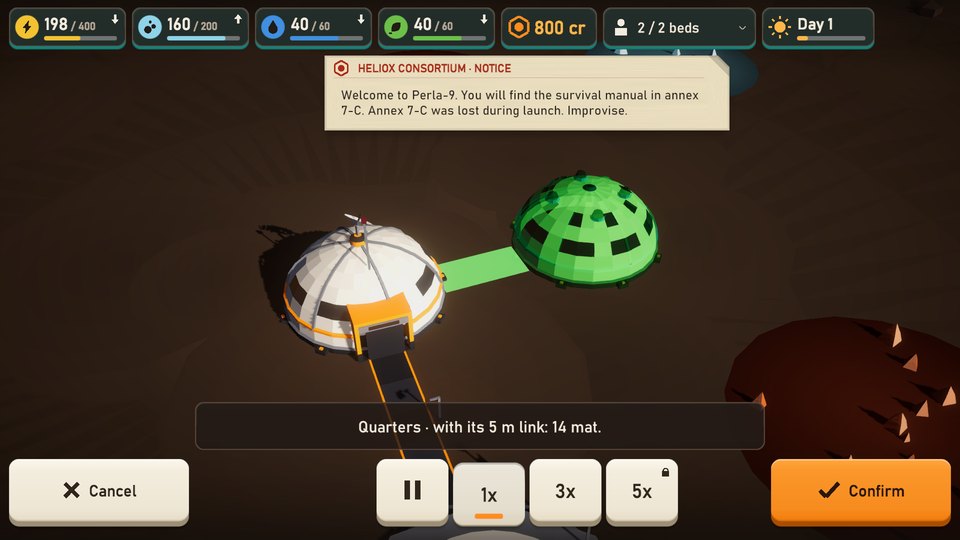
Pick one and its ghost appears where you are looking. Move it by dragging with your finger on it, or by tapping the ground where you want it.
The game proposes the link to the nearest valid structure by itself. Tapping another structure says “link it to this one”; tapping it again hands the choice back to the game.
A strip says what is being placed and what it costs with its link (“Quarters · with its 5 m link: 14 mat.”), or why it will not go there.
Confirm sets aside the materials for the structure and its link and leaves a site. Cancel drops it. Nothing is placed when you lift your finger.
Placing: the ghost, its link and “Confirm”The Heliox supply catalogue
Blueprints: what money is for
A blueprint is bought once per contract and covers every unit of that structure on that asteroid. You buy it in the catalogue, with two taps: the card asks “Buy it?”.
The blueprints that come with the contract are the same on every asteroid: Solar Array, Battery, Quarry, Ice Extractor, Life Support, Quarters, Greenhouse and Recycler. They are what it takes not to die and to have materials. Surviving never waits for money.
Rank says which blueprints are offered; money, which you hold. Money does not travel from one asteroid to the next, and neither do blueprints.
HELIOX CONSORTIUM · NOTICE
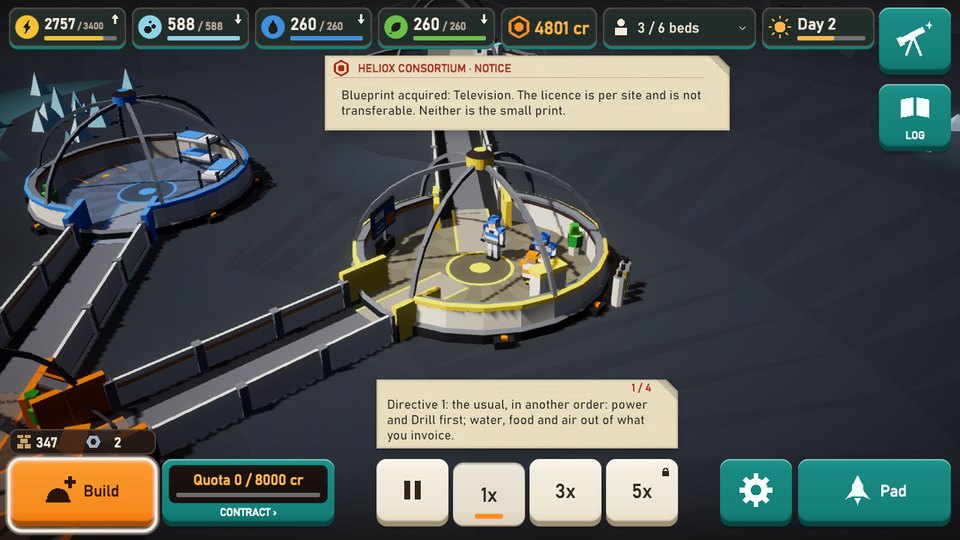
Blueprint acquired: Drill. The licence is per site and is not transferable. Neither is the small print.
Materials: what everything is made of
Every contract opens with a founding lot (on Perla-9, 100 materials): it pays for the survival opening and the first Quarry. From there on, the base lives off its rock.
The Quarry is a rig that goes anywhere in the basin, with no deposit and no staff: it gives 0.15 materials a second and uses 4 power. At night, with the base on its reserve, it waits like a drill.
Materials have no ceiling: they are stockpiled in the open. How many there are is on the strip at the bottom left, next to the repair parts, and at the head of the catalogue.
An asteroid's carriage does not make building dearer: a material is a material on any rock.
The site: the technician raises it
Sites: one standing, another half upA site's card: how far along it is and who is raising it
A site is the plan marked on the ground, with its stakes and its stockpile. It makes nothing, holds nothing and does not count as built. The structure rises out of the ground as the work goes in.
A free technician goes unprompted: he walks along the network to the site and works at it, outside, in plain sight. Each structure takes from 8 to 30 seconds of work, and each link its own by the metre. Only the time he is there counts: if he goes to eat, to sleep or to take cover, the site waits as far as it got.
One technician to a site, and the sites in order: the one you placed first goes first. With two technicians, two sites at once. A site that hangs from another waits for that one to stand.
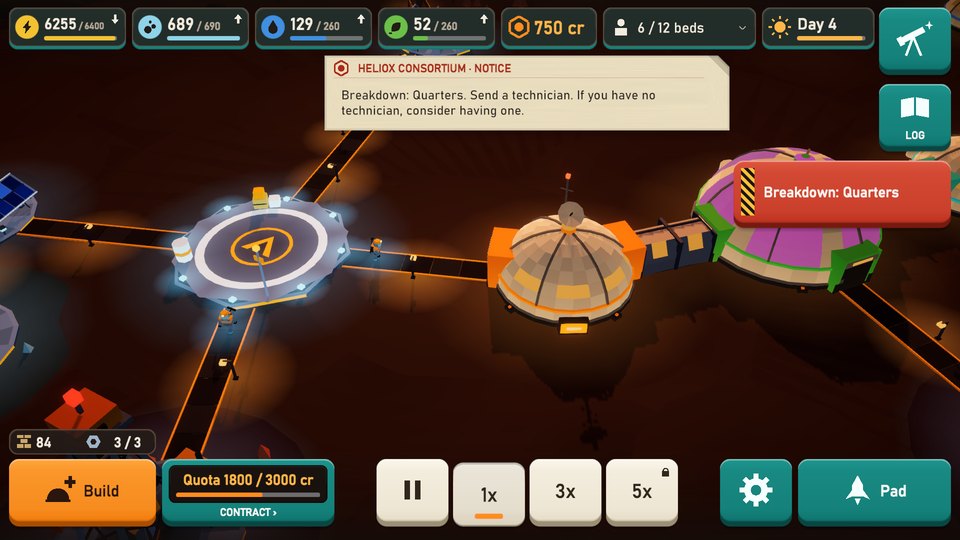
The site's card says how far along it is and who is raising it (“Site: 46 % · raised by Technician no. 2”), that it is waiting for a technician, or that there is none. With no technician on the staff at all there is an alert as well: “Works stopped: no technician”. Tapping it takes you to the site.
A site is given up from its card, with two taps, and gives back all its materials: Cancel.
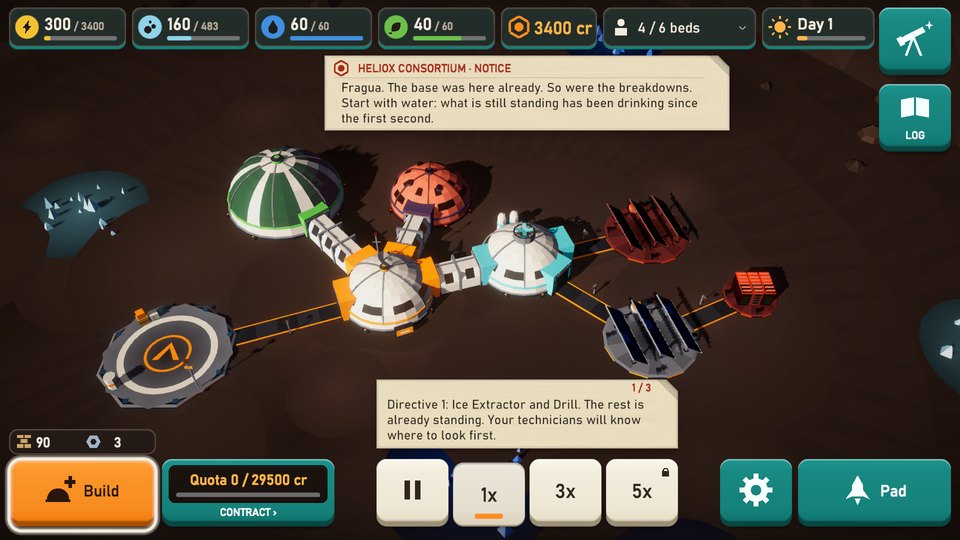
The Command Module, the Landing Pad and, where there is an inherited base, what was inherited stand from the first second.
Where it can go
Inside the basin, the flat floor of the crater.
3 m or more from the edge of any other structure.
With a link that is not over length, does not cross another link and does not run through another structure.
On its deposit, if it needs one: the Drill on a seam (on Perla-9, the reddish patches); the Ice Extractor on ice (the blue patches).
And with materials for it and for its link.
When it will not go, the ghost says why: “Outside the basin”, “Too close to something else”, “It has to sit on its deposit”, “There is nothing to link it to”, “Too far for a link”, “The link runs into something”, “That deposit is spent”, “Not enough materials”.
Links
The colony is a network: if a structure is linked, it works and people can reach it. There are two kinds of link, and a third where the ground is split.
The whole colony: a network
Link
Joins
Maximum length
Costs
Corridor
One dome to another. It is pressurised.
24 m
0.6 materials and 0.5 s of work per metre
Walkway
A rig to any structure. A lit path with its cable.
40 m
0.2 materials and 0.2 s of work per metre
Bridge
Whatever crosses a chasm, on an asteroid of tablelands (the reliefs). It is never a corridor: you cross it in the open.
32 m
0.6 materials and 0.6 s of work per metre
The link is rounded up to a whole material, and the technician who raises the site lays it. To run one more link (a short cut or a ring): a structure's card, Link, then tap the other one; it is a job like any other, and waits for a technician. A link can be tapped too, and its card lets you remove it, with two taps, if that cuts nobody off.
Demolishing
Demolish is on the card, asks for two taps and gives back half its materials. It is refused if it breaks the network, and says whom it would cut off. The Command Module and the Landing Pad cannot be demolished.
Deposits run out
Ore seams and ice sheets are finite. When one runs out a notice arrives and whatever sat on it stops (“Stopped: the deposit is spent”): time to extend the network to another.
Carriage
The prices in credits in this manual are those of Perla-9. The farther the asteroid, the more everything paid for with money costs: blueprints, staff, upkeep, the advance and the Exchange are multiplied by each site's carriage, from ×1 to ×4.5 (the thirty asteroids). What is paid for in materials costs the same everywhere.
What is not delivered
On some sites the Company does not sell the blueprint of a structure: its card stays in the catalogue, sealed, reading “Not delivered here”. On others it charges more for one than carriage alone. The asteroid's file states both before you sign.
Ascua: the Reactor, sealed
06The nine resources
Nine. The first four keep the staff alive; ore and refined metal are for invoicing; materials and parts are what you build and mend with; and money buys what the rock does not give.
Resource
Comes from
Used by
Power
Solar Array (by day) and the Reactor.
Nearly everything that runs. Whatever is left over charges the batteries.
Air
Life Support, from water and power. The Command Module gives a little.
The staff, and leaks. It is one reserve for the whole pressurised network.
Water
Ice Extractor; where there is no ice, the Recycler.
Life Support, the Greenhouse and the staff.
Food
The Greenhouse.
The staff, in rations.
Ore
A Drill on a seam, with a miner.
The Refinery; or it is invoiced as it is.
Refined
The Refinery: 2 of ore make 1.
It is invoiced: it is worth 2.5 times the ore.
Materials
The Quarry, out of the rock; the founding lot; and the Exchange, for money.
All building: structures, links, the modules inside a dome and repair parts.
Parts
A technician at the bench of the Command Module or the Workshop, out of 4 materials each.
One for each breakdown mended.
Credits
Invoicing at the Pad.
Blueprints, staff, the Exchange, the Reactor's upkeep and the transfer.
What people use
One person breathes 0.1 of air a second, drinks 0.01 of water a second and eats a ration every 5 minutes.
Every dome and every metre of corridor leaks a little air, working or not.
With no air the alarm sounds; after 1 minute, the staff lose health.
When power runs short
Things switch off by priority, in this order: Drill → Refinery, Entertainment room → Quarry, Canteen → Greenhouse, Radio → Ice Extractor, Storehouse → Quarters → Recycler, Infirmary, Laser Tower, Workshop → Life Support → Command Module. Mining goes first; the Command Module, last of all.
The vital reserve. Half of what the batteries hold is for the vital things alone: Command Module, Life Support, Recycler, Infirmary, Laser Tower and Workshop. Nothing else may take the batteries below that: it goes to “Standing by: the batteries are keeping the vital reserve” and comes back by itself when there is power.
That is why a base short of batteries stops mining halfway through the night. That is the base working, not a breakdown: no alarm sounds.
Nothing overworks
A plant makes only what its store has room for. With the reserve nearly full it runs at a fraction and uses that same fraction of what it consumes, power included. With the store full, it stops.
Storage comes mostly from the Command Module, the Landing Pad, batteries and the Storehouse; every dome also holds a little air. Materials and parts have no ceiling. Each asteroid has a single ore: the price changes, the way you play does not.
07Repair parts and the Exchange
Repair parts
A part is what is used up mending something that has broken down: one per breakdown. Sealing a hull — a crack or a breach — uses none. Every contract opens with two; how many there are is on the strip at the bottom left, next to the materials.
The bench: the Command Module's cardA breakdown with no part
They are made like a building: out of materials and by a technician. Each part costs 4 materials and 20 seconds of a technician at the bench in the Command Module; a Workshop is a better bench, 10 seconds a part. The bench works even if its dome has broken down.
The standing order. You do not ask for them one by one: on the Command Module's card, the Parts to keep: 3 key sets how many the base is to keep in store, from 0 to 6; each tap, one more. The bench orders by itself: while there are fewer than the standing order, or than things broken down and waiting, it sets aside the materials for one and leaves it on order.
With no part, what has broken down stays broken: its card says so, the alert “A repair part is needed” comes up and the technician goes to the bench before any site.
The improvised part. With something broken down, no part, no materials to order one with and none on its way, the technician makes do at the bench, out of nothing, in three times as long. It gets you out of a hole; it is no substitute for spares.
The decision is how many materials to tie up in spares before a meteor shower.
The Exchange: trading by radio
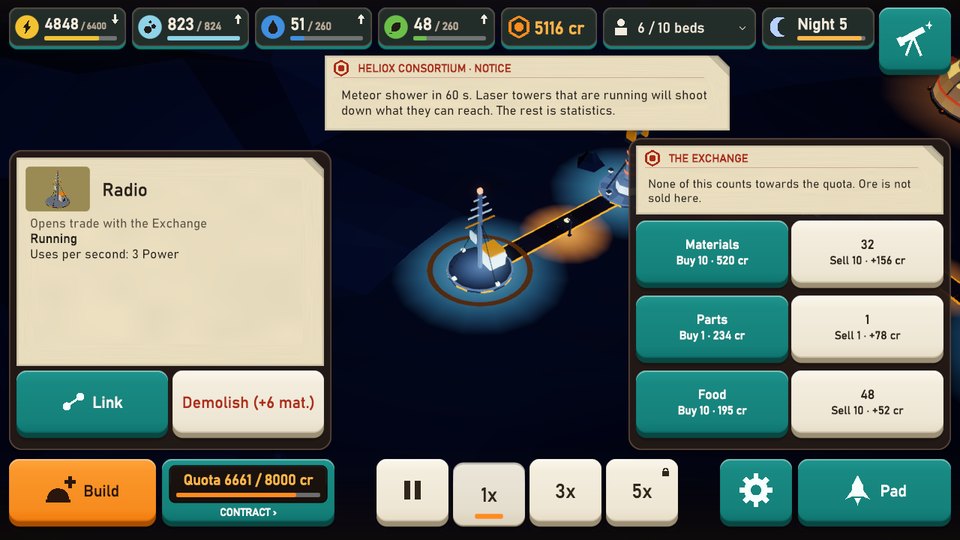
The Exchange is the belt's market: independent traders who answer to a radio. With no Radio running there is no trade. Tapping a Radio that stands brings up, beside its card, the Exchange's tray: a row for each kind of goods, with its two keys, buy and sell.
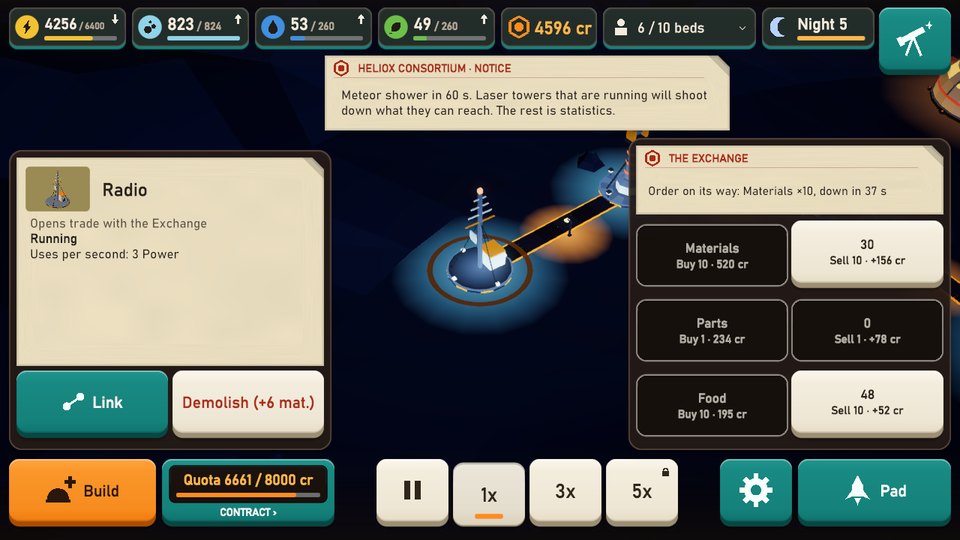
The Radio and the Exchange's trayAn order on its way
Goods
Lot
Bought at
Sold at
Materials
10
400 cr a lot (40 cr each)
120 cr a lot (12 cr each)
Parts
1
180 cr
60 cr
Food
10
150 cr a lot (15 cr each)
40 cr a lot (4 cr each)
Buying is charged on ordering and comes down to the Landing Pad by drone in 45 seconds; one order at a time. Selling is paid on the spot. Every price carries the asteroid's carriage.
None of it counts towards the quota, and ore and refined metal are not sold here: they are the Company's. The tray says so: “None of this counts towards the quota. Ore is not sold here.”
It is for buying time: with money to spare and a slow quarry, you pay; short of money, you wait for your rock. And for getting out of a hole: food with no Greenhouse, a part with no materials.
With the pad closed there is no Exchange; with the Radio out of power, none either. In a tender, the other corporation buys at the same Exchange and prices go up with what each of you takes.
HELIOX CONSORTIUM · NOTICE
Your order from the Exchange is in: Materials, 10. The Company does not vouch for what it does not sell.
08The almanac, the log and the staff
How much there is can be read off the gauges. Who makes it, who uses it, how it has gone these last days and what has happened is asked by touching them: each gauge opens its own.
The staff, by trade
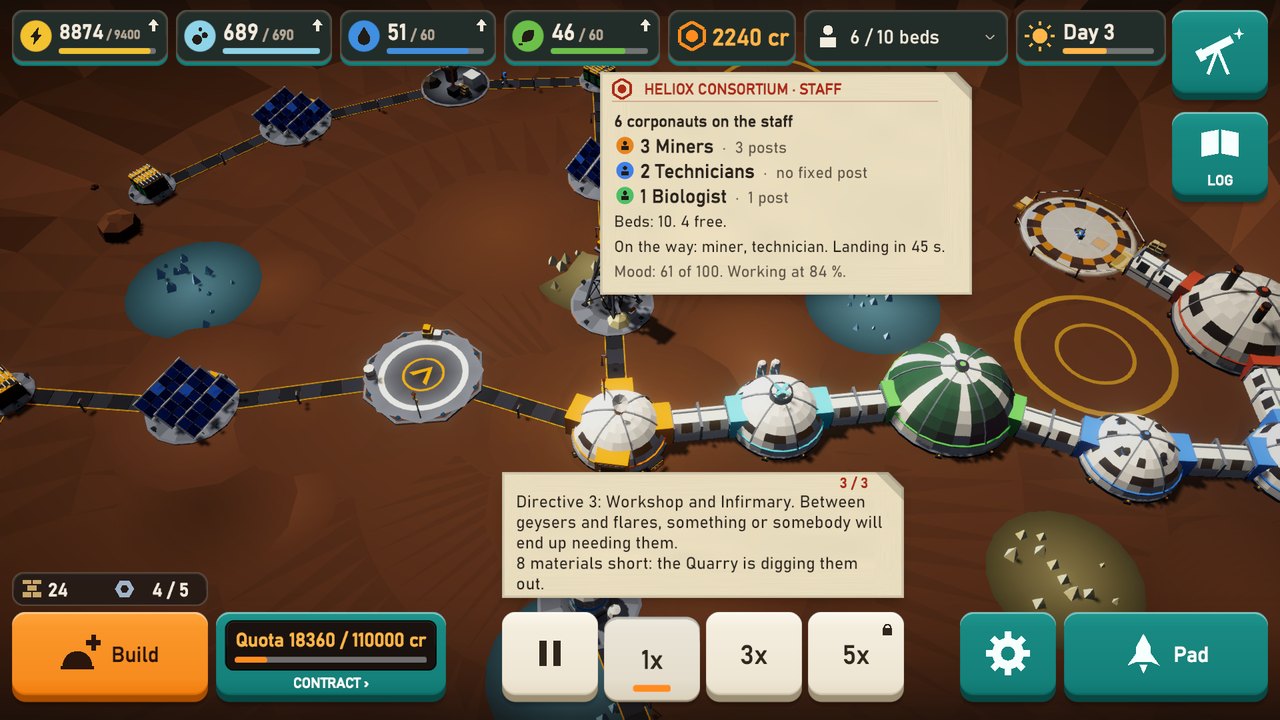
The staff by trade, let down from their gauge
The beds gauge lets down a sheet of paper that hangs from it. It has no keys: it is put away by tapping off it, with Back, or by opening something else.
How many there are, and a line for each trade in its colour: Miners, Technicians and Biologists.
The posts, beside them: “2 Miners · 3 posts, 1 unfilled”. “How many miners have I got” is only useful next to “how many do I need”.
The beds: “Beds: 10. 6 free.”, or how many are sleeping on the floor.
Who is on the way and how long they will be, when staff have been requested at the Pad.
Mood and the rate of work, and those lost on this contract, if any.
The almanac
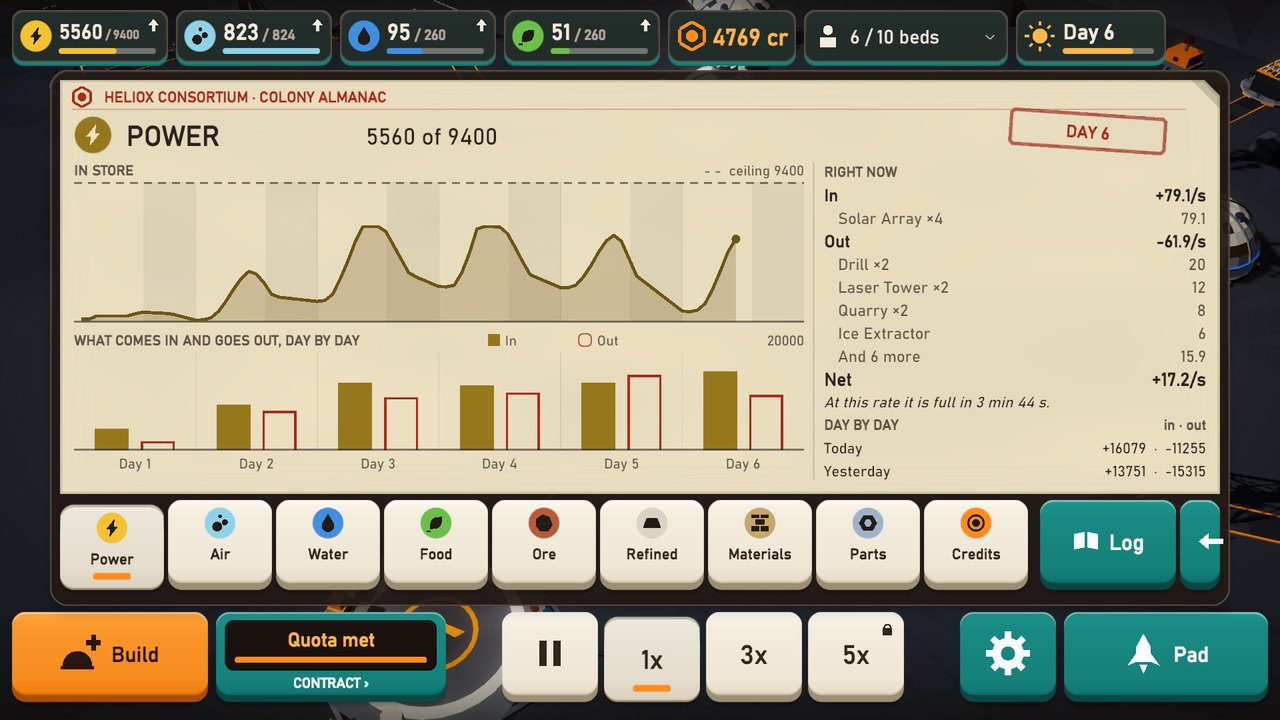
The almanac: the power sheet
It is a Company paper that hangs under the gauges, with a sheet for each resource. That resource's gauge opens it; Ore and Refined have no gauge, and are reached with the keys on the tray, one per resource.
In store: the curve of how much there has been these last days, with the nights as darker bands, the ceiling as a dashed line and a dot where it stands now. It answers “am I running out of water?”.
What comes in and goes out, day by day: two bars a day, solid for what came in and hollow for what went out. It answers “am I using more than I make?”.
Right now, on the right: “In”, with the total per second and who makes it (“Solar Array ×3”); “Out”, with who uses it — the structures, “The staff”, “Leaks from domes and corridors”; and the “Net”.
Where it is heading: “At this rate it is gone in 6 min 10 s.”, or how long until it is full; “Neither rising nor falling.”; “Full: what is left over is lost.”
Below, the days in figures, newest first. The almanac keeps the last 10 days.
Credits do not come and go by the second: “In with every shipment, out with every purchase.” Their sheet shows the days.
The card of a structure that is “about” one resource — a Battery, about power — says it too, in two lines: “Power across the base: in 27.8/s, out 45/s”, and where that is heading. The detail is in the almanac.
The mission log
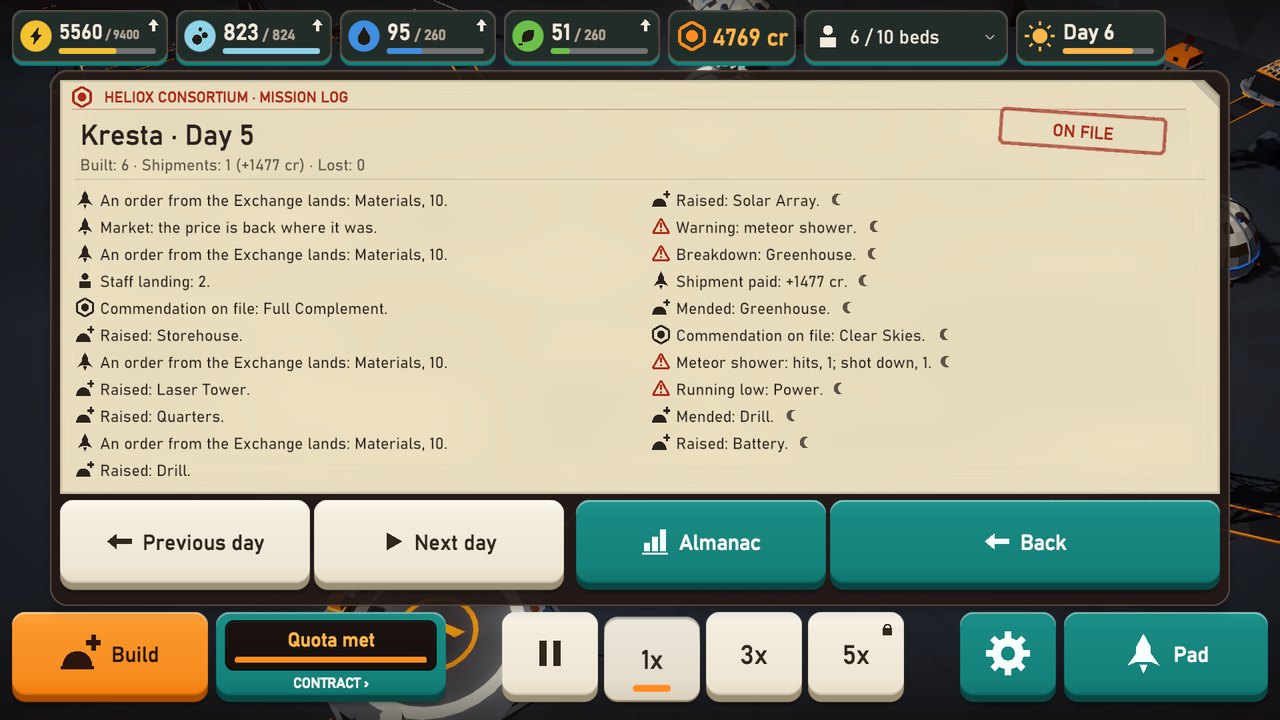
The mission log: a day to a sheet
Everything that has happened, a line for each thing and a day to a sheet. It opens with the day gauge, with the LOG key in the corner, or with the almanac's Log key.
At the top, the asteroid and the day, a summary — “Built: 3 · Shipments: 1 (+482 cr) · Lost: 0” — and the stamp “TODAY” or “ON FILE”.
Each line, one fact: what is assembled and taken down, shipments and what they paid, who lands and who is lost, each hazard with its warning and how it ended, breakdowns and their repairs, shortages, power cuts, promotions and directives done.
Before it, a pictogram for its kind — building, pad, staff, hazard, Company; after it, a moon if it happened at night.
Previous day and Next day turn the sheet, skipping days with nothing on them. Open at today, what happens is seen being written.
It keeps the last 160 lines. A day with nothing says: “Nothing to report. The Company is moderately pleased.”
None of this pauses the game or changes a figure: it is there to be read. A game begun with an earlier version loads as it was: its almanac starts on the day it is taken up again, and its log is written from the notices it had kept.
09The structures
Eighteen in the catalogue and two supplied by the Company. Each card says what the structure gives and uses as delivered, what each unit costs in materials and in seconds of work, and its blueprint: supplied with the contract, or its price on Perla-9 (on the other asteroids it is multiplied by the carriage). A dome also lists its holes: what it comes with and what else it takes (inside the domes).
Supplied by the Company
Command Module
Where the staff sleep and eat
Supplied by the Company. One only: it never breaks down and cannot be demolished.
Makes per second: 0.4 Air
2 beds
Stores 200 Air, 60 Water, 60 Food, 400 Power
Uses per second: 1 Power
Bench: a repair part in 20 s
Two beds, a little air and a small larder. Its power reserve carries it alone through the Perla-9 night.
Dome · Ø 10 mSupplied
Landing Pad
Where the shuttles land
Supplied by the Company. One only: it never breaks down and cannot be demolished.
Stores 120 Ore, 60 Refined
The freighter and the staff shuttle land here. It holds whatever is waiting to be loaded.
Rig · Ø 14 mSupplied
From Intern
Solar Array
Power while the sun is up
Makes per second: 30 Power with the sun overhead; less when it is low and nothing at night
They follow the sun: output goes with its height.
Rig · Ø 10 m · 6 mat. · 10 s of workBlueprint supplied
Battery
To get through the night
Stores 3,000 Power
What is left over by day is kept here for the night.
Rig · Ø 6 m · 8 mat. · 8 s of workBlueprint supplied
Quarry
Digs materials out of the rock
Makes per second: 0.15 Materials
Uses per second: 4 Power
It goes anywhere in the basin. Without one, your materials are those of the lot and whatever the Exchange sells.
Rig · Ø 10 m · 8 mat. · 12 s of workBlueprint supplied
Ice Extractor
Draws water from ice
Makes per second: 0.6 Water, on ice
Uses per second: 6 Power
Ice runs out too.
Rig · Ø 10 m · 10 mat. · 14 s of workBlueprint supplied
Life Support
Makes air out of water
Makes per second: 3 Air
Stores 60 Air
Uses per second: 0.3 Water, 4 Power
Vital: keeps running at night on the reserve
3 holes; as delivered: 2 × Scrubber. It also takes: Air tank
Without water it makes no air.
Dome · Ø 10 m · 12 mat. · 16 s of workBlueprint supplied
Quarters
Beds for the staff
4 beds
Stores 60 Air
Uses per second: 2 Power
3 holes; as delivered: 2 × Bunk. It also takes: Lockers, Washroom
You need a bed per person.
Dome · Ø 10 m · 10 mat. · 14 s of workBlueprint supplied
Greenhouse
Grows food with water
Makes per second: 0.025 Food
Stores 120 Air
Uses per second: 0.1 Water, 5 Power
Makes ×1.5 with a biologist
5 holes; as delivered: 2 × Planter. It also takes: Drip line, Grow lamps
Feeds about seven people.
Dome · Ø 14 m · 14 mat. · 20 s of workBlueprint supplied
5 holes; as delivered: Racking, Cistern, Cold store
With the reserves full, whatever produces stops.
Dome · Ø 14 m · 12 mat. · 16 s of workPlan 300 cr
Radio
Opens trade with the Exchange
Uses per second: 3 Power
With it running, the Exchange answers
Tapping it opens the Exchange. With no power, or with the pad closed, nobody answers.
Rig · Ø 6 m · 10 mat. · 8 s of workPlan 300 cr
From Foreman
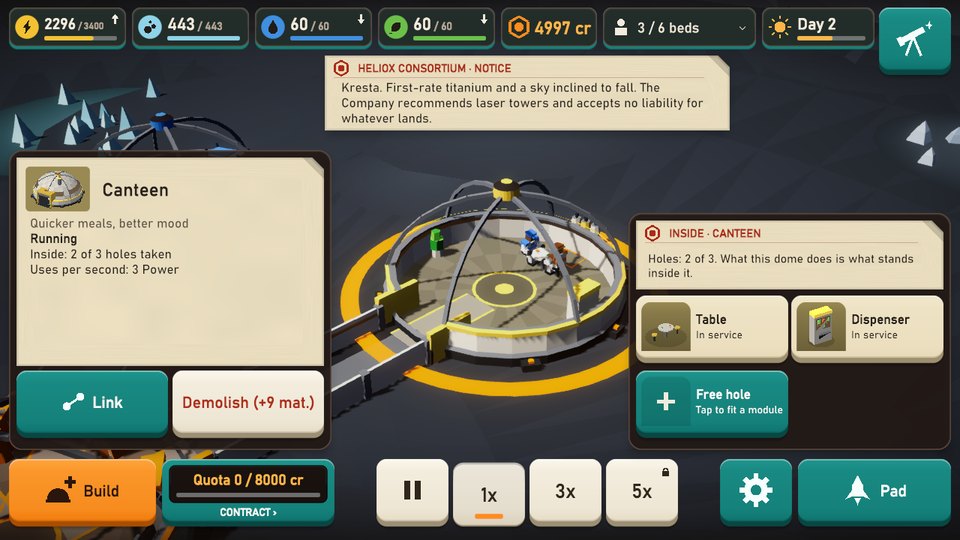
Canteen
Quicker meals, better mood
Stores 60 Air
Uses per second: 3 Power
Eating here takes half the time and gives +8 mood
3 holes; as delivered: Table, Dispenser. It also takes: Television
Two eat at a time per Table; anybody with no seat eats at another or in the Command Module.
Dome · Ø 10 m · 12 mat. · 14 s of workPlan 300 cr
Refinery
Turns ore into refined metal
2 Ore make 1 Refined; up to 0.2 Refined a second
Stores 120 Air
Uses per second: 12 Power
Post: one miner
5 holes; as delivered: 2 × Furnace. It also takes: Hopper
Refined metal is invoiced at 2.5 times the ore, and the freighter loads it first.
Dome · Ø 14 m · 28 mat. · 22 s of workPlan 700 cr
Recycler
Finds water where there is none
Makes per second: 0.3 Water
Stores 60 Air
Uses per second: 8 Power
Vital: keeps running at night on the reserve
3 holes; as delivered: 2 × Filter. It also takes: Cistern
The answer to an asteroid with no ice.
Dome · Ø 10 m · 24 mat. · 18 s of workBlueprint supplied
Infirmary
Treats the injured
Stores 60 Air
Uses per second: 4 Power
Post: one biologist
Heals 2 health a second · 2 places
Vital: keeps running at night on the reserve
3 holes; as delivered: 2 × Cot. It also takes: Dispensary
Anybody whose health falls below 60 goes there unprompted. The biologist takes charge when somebody is hurt; once they are well, back to the greenhouse.
Dome · Ø 10 m · 18 mat. · 16 s of workPlan 450 cr
Laser Tower
Shoots down nearby meteors
Uses per second: 6 Power
Reach: 28 m
Vital: keeps running at night on the reserve
Shoots down every meteor that falls within its reach, if it has power.
Rig · Ø 6 m · 20 mat. · 12 s of workPlan 500 cr
From Supervisor
Entertainment room
Restores morale
Stores 60 Air
Uses per second: 4 Power
4 places · +1.5 mood a second, up to 85
3 holes; as delivered: Games table. It also takes: Television, Projector, Gym, Viewing port
Used by anybody whose mood is below 40. How high it raises it depends on how many different kinds of entertainment the base has.
Dome · Ø 10 m · 16 mat. · 14 s of workPlan 400 cr
Workshop
A fast bench, and drones that repair
Stores 60 Air
Uses per second: 10 Power
Its drones repair in 30 s
Bench: a repair part in 10 s
Vital: keeps running at night on the reserve
3 holes; as delivered: Bench, Drone dock
Its drones seal cracks and breaches and repair breakdowns with no technician; a breakdown costs them a part, as it does anybody. And it is the fast bench.
Dome · Ø 10 m · 32 mat. · 18 s of workPlan 800 cr
From Site Director
Reactor
Power day and night
Makes per second: 60 Power
Upkeep: 5 cr a minute
It never shuts down for lack of funds: whatever could not be paid is added to what you owe the Company.
Rig · Ø 14 m · 80 mat. · 30 s of workPlan 2000 cr
10Inside the domes: their modules
A dome is a shell with holes, and it does what is inside it. There are three in those of 10 m and five in those of 14 m. Each kind is delivered with the fittings that make it what it is — a Canteen, with its Table and its Dispenser —; what is new is the hole left over, and what you decide to put in it.
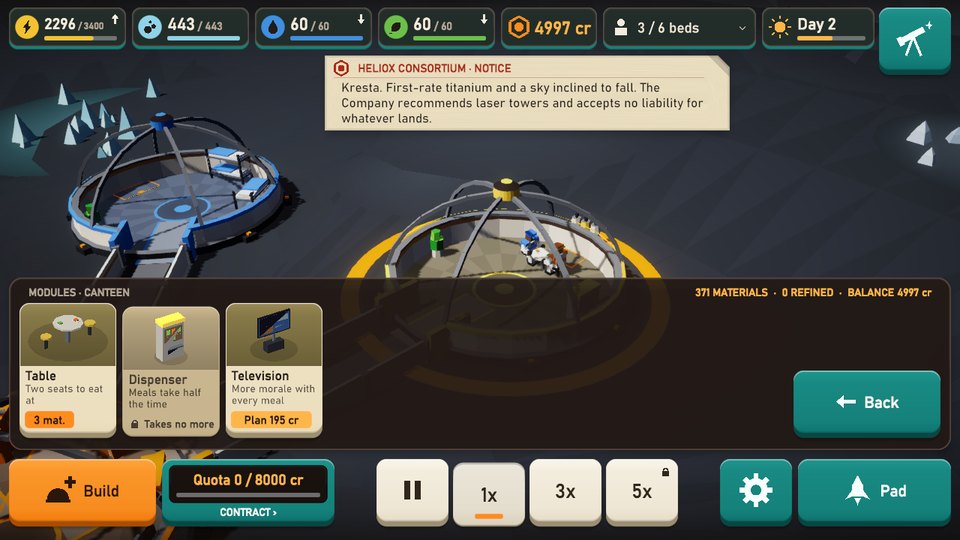
A dome's card and the tray of its holesWhat a free hole takes
Tap a dome and, beside its card, the tray of its holes comes up: what is in each, and those that are free.
A free hole shows what that dome takes, each module with what it costs. Those with a blueprint of their own are bought right there, with two taps, like any blueprint.
Pick one, its materials are set aside — and its refined metal, if it asks for any — and the technician fits it, inside, as one more job in its turn.
Taking a module out asks twice and gives back half.
The technician fits a moduleA full Canteen: table, dispenser and television
What you see inside a dome is what has been built in it. Bring the camera close and the domes open to show their room, with whoever is in it and with a module half done while the technician fits it.
There are twenty-five modules. Nine have a blueprint of their own, from 100 to 250 cr, and six also ask for refined metal: it is the second building material, and spending it on a module is not selling it.
A game begun with an earlier version opens with every dome carrying what it is delivered with: it does what it did.
The twenty-five modules
Module
Goes in
What it does
In figures
Costs
Blueprint
Bunk
Quarters
Two beds.
+2 beds; uses 1 Power a second.
3 mat. · 4 s
supplied
Lockers
Quarters
Better morale on waking.
+4 mood on waking.
4 mat. · 4 s
Plan 100 cr · 1 to a dome
Washroom
Quarters
Rest comes a quarter sooner.
Rest comes 25 % faster; uses 1 Power a second.
5 mat. + 2 ref. · 6 s
Plan 150 cr · 1 to a dome
Table
Canteen
Two seats to eat at.
+2 places to eat; +4 mood at a meal; uses 1 Power a second.
3 mat. · 4 s
supplied
Dispenser
Canteen
Meals take half the time.
+4 mood at a meal; a meal takes ×0.5 of the time; uses 2 Power a second.
3 mat. · 4 s
supplied · 1 to a dome
Television
Canteen and Entertainment room
More morale with every meal.
+6 mood at a meal; +4 places to unwind; uses 1 Power a second.
4 mat. + 2 ref. · 5 s
Plan 150 cr · 1 to a dome
Scrubber
Life Support
Makes air out of water.
Makes 1.5 Air a second; uses 0.15 Water, 2 Power a second.
3 mat. · 4 s
supplied
Air tank
Life Support
A larger reserve of air.
Holds 150 Air.
4 mat. · 4 s
supplied
Planter
Greenhouse
Grows food with water.
Makes 0.0125 Food a second; uses 0.05 Water, 2.5 Power a second.
4 mat. · 5 s
supplied
Drip line
Greenhouse
The dome uses less water.
The dome uses ×0.6 the Water.
4 mat. · 4 s
Plan 100 cr · 1 to a dome
Grow lamps
Greenhouse
Each planter gives a quarter more.
The dome makes ×1.25 the Food; uses 2 Power a second.
5 mat. + 3 ref. · 5 s
Plan 200 cr · 1 to a dome
Racking
Storehouse
Holds ore and refined metal.
Holds 300 Ore, 150 Refined.
2 mat. · 3 s
supplied
Cistern
Storehouse and Recycler
A larger reserve of water.
Holds 200 Water.
2 mat. · 3 s
supplied
Cold store
Storehouse
A larger reserve of food.
Holds 200 Food; uses 1 Power a second.
2 mat. · 3 s
supplied
Furnace
Refinery
Refines ore.
Refines 0.1 a second; uses 6 Power a second.
8 mat. · 6 s
supplied
Hopper
Refinery
Holds more ore.
Holds 150 Ore.
4 mat. · 4 s
supplied
Filter
Recycler
Recovers water.
Makes 0.15 Water a second; uses 4 Power a second.
7 mat. · 5 s
supplied
Cot
Infirmary
A place for one of the injured.
+1 place to heal; uses 2 Power a second.
5 mat. · 4 s
supplied
Dispensary
Infirmary
Healing goes half as fast again.
The dome heals at ×1.5 the rate; uses 1 Power a second.
4 mat. + 2 ref. · 4 s
Plan 150 cr · 1 to a dome
Bench
Workshop
Parts in half the time.
Bench: a part in 10 s; uses 4 Power a second.
8 mat. · 5 s
supplied · 1 to a dome
Drone dock
Workshop
They mend with no technician.
+1 drone; repairs in 30 s; uses 6 Power a second.
12 mat. · 7 s
supplied · 2 to a dome
Games table
Entertainment room
Four places to unwind.
+4 places to unwind; uses 4 Power a second.
8 mat. · 6 s
supplied
Projector
Entertainment room
Two places; eight by night.
+2 places to unwind; +6 more at night; uses 3 Power a second.
6 mat. + 3 ref. · 6 s
Plan 250 cr · 1 to a dome
Gym
Entertainment room
Two places, and it heals. Technicians’ pick.
+2 places to unwind; gives back 0.5 health a second; uses 2 Power a second.
6 mat. + 2 ref. · 6 s
Plan 200 cr · 1 to a dome
Viewing port
Entertainment room
Two places. Biologists’ pick.
+2 places to unwind.
5 mat. · 5 s
Plan 100 cr · 1 to a dome
Entertainment
The Entertainment room, inside
The Entertainment room is where anybody whose mood is low brings it back up. It is delivered with a Games table; its holes take five kinds of entertainment: Games table, Television, Projector, Gym, Viewing port.
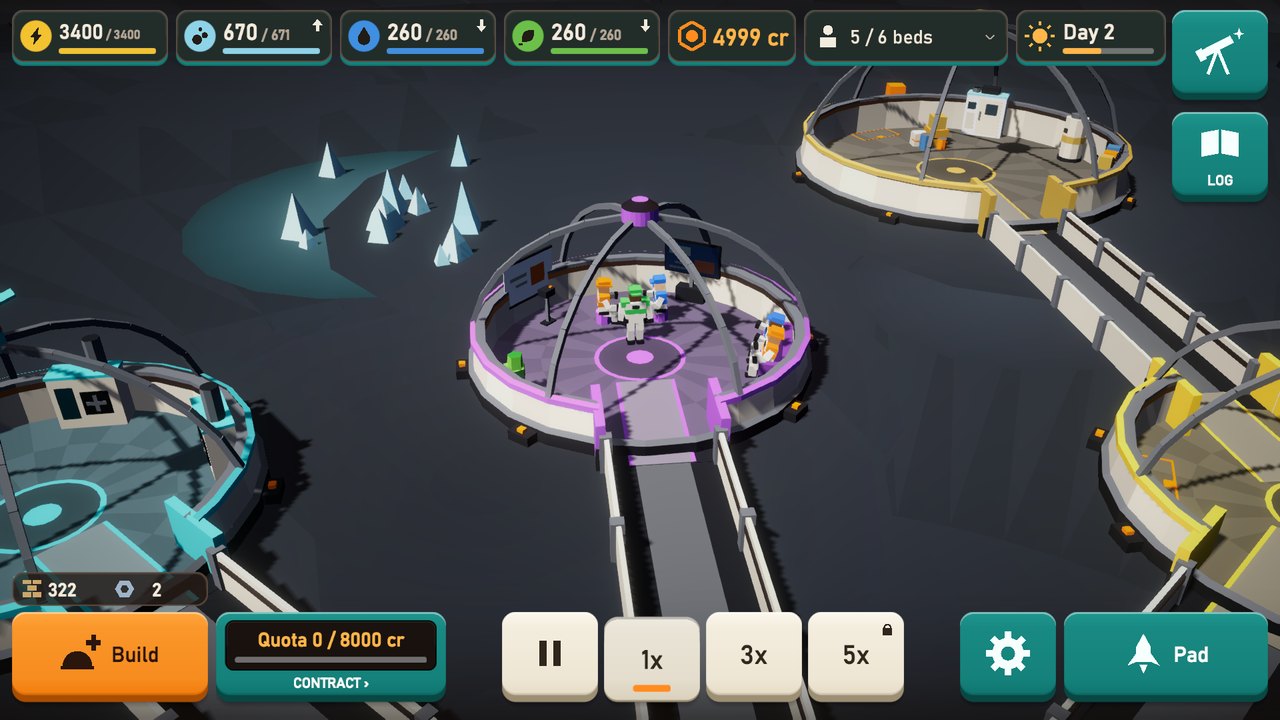
Variety counts. A room raises mood as far as 85; for each further different kind the base has, in whatever dome, that ceiling goes up by 4, as far as 97. Three televisions amuse nobody more than one.
Each trade has its taste: the miner, the Television; the technician, the Gym; the biologist, the Viewing port. Where its favourite stands, mood comes back twice as fast. The room's card says so.
The Projector has a night session: more places when there is no sun. The Gym gives back health besides. And a Television also goes in a Canteen, where it is company at a meal.
The Heliox Channel. With a screen on the base — a television or a projector in a dome that is running — the Company has a line to say every nightfall.
HELIOX CONSORTIUM · NOTICE
Heliox Channel. The Company reminds you that watching television counts as rest, and rest counts as a favour.
11The corponauts
The Company says “corponauts”. You request them at the Pad: 100 cr each, two at a time, and the shuttle takes 45 s. Before requesting them you choose each post's trade: tapping the post changes it.
Trade
What they do
Miner
Works the Drill and Refinery.
Technician
Raises the sites, lays the links and fits the modules inside a dome; makes the repair parts at the bench; repairs breakdowns (20 s and a part) and seals cracks and breaches. With no technician nothing gets built.
Biologist
Lends a hand in the Greenhouse (×1.5) and runs the Infirmary when somebody is hurt.
A corponaut's card
They look after themselves
Nobody gives them orders. In this order: they take cover, eat, sleep, work and rest.
They share themselves out by trade, to the nearest free post where there is something to do. A drill on a spent seam or a refinery with no ore does not count while another post is waiting.
Each has health, food, rest and mood. They show on their card, next to what they are doing (“At their post”, “Eating”, “Taking cover”…).
You need a bed per person. Anybody without one sleeps on the floor: they rest at half the rate and their mood drops.
People still eat in a dome that has broken down.
The technician sees to a crack or a breach before dinner and bed, and before a breakdown. Air does not wait.
A technician's day, in this order: mend what has broken down if there is a part — what matters most to the base first, wherever it is —; make the part if something is waiting and there is none; raise the oldest site; and, with no site, stock the store with the parts the bench has on order.
You can see a corponaut at work: they walk, carry, raise a site standing beside it, and each trade wears its colour on the suit. Inside an open dome you see them at the table, in their bunk or in front of the screen (inside the domes).
Mood sets the pace
Staffed work runs at between 60 % and 100 % depending on the staff's average mood. The post's card says so: “Working at 84 % for the staff's spirits”. The Canteen and the Entertainment room raise it, and more so the more varied what there is to unwind with (inside the domes); going hungry, sleeping on the floor and, above all, losing somebody bring it down.
It does not settle the same on every posting: there are unpopular sites where mood stays lower, and their file warns you. Below an average of 40, where there are stoppages, the staff call one (alerts and hazards).
Health
It falls when a need goes unmet for too long or when a hazard injures somebody. With everything covered it recovers by itself, slowly; below 60 they walk to the Infirmary, if there is one. If they all die, the contract is rescinded and the asteroid starts again. Your rank is kept.
HELIOX CONSORTIUM · NOTICE
2 corponauts have arrived. They come motivated. Do try not to spoil it too soon.
12Day and night
The asteroid rotates. By day there is sun and the Solar Array gives according to its height; by night it gives nothing and the base lives on what the batteries hold, or on a Reactor.
These are minutes at 1x speed. On Cenit night never falls: the sun dips to the horizon and climbs again. On Estigia the day lasts 30 s and the night 9 min 30 s.
At night the base is seen by its own light
The base at nightDusk
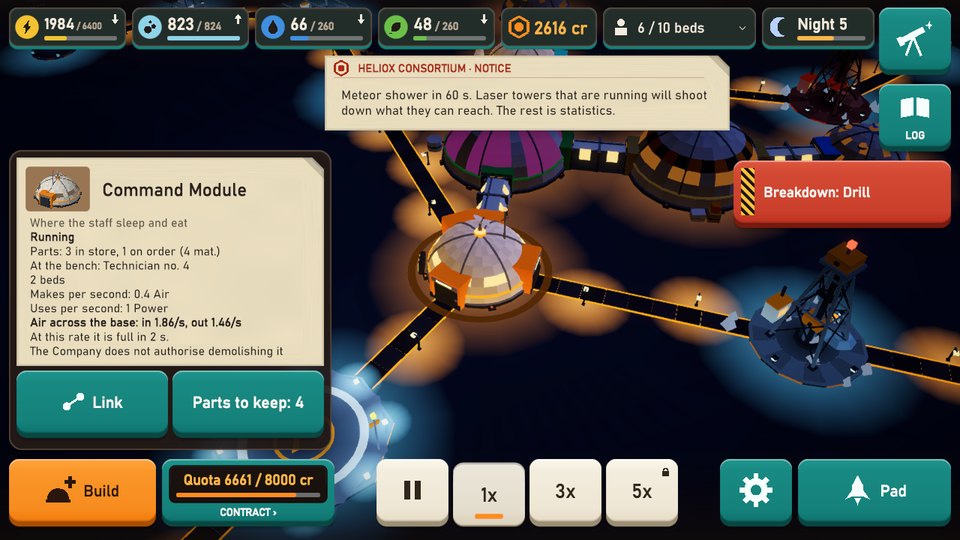
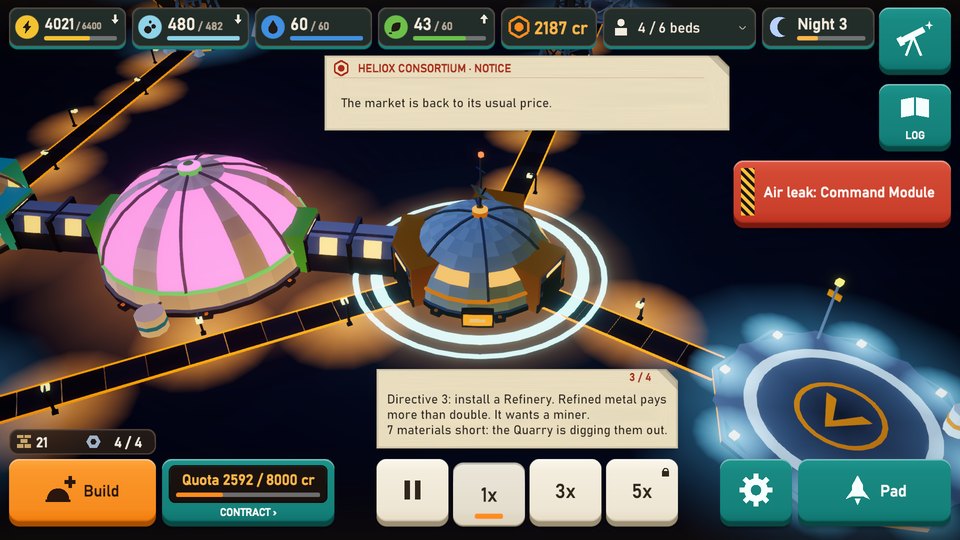
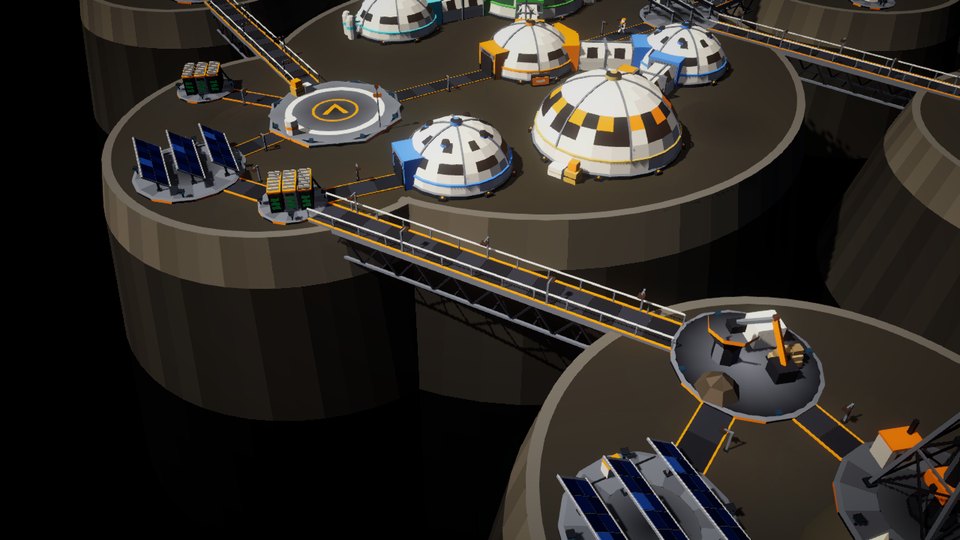
The night is dark. The ground goes almost black, and what you see is what has light: the domes with their windows, the pad with its beacons, the lit edges of the walkways.
Every structure lights itself. It carries its floodlights on the edge of its platform and leaves a pool of light on the ground it stands on. They come on as the sun goes down and go off at dawn.
What has failed is what is not lit. A building with “No power” goes dark: at night, one unlit structure in the middle of the base is the first thing to look at. One that is “Standing by”, broken down or breached gives less light.
Dusk and dawn go through orange and violet, and the base still reads while the light changes.
You can see the corponauts. The suit gives a little light of its own, the band of their trade glows — at night you can tell a miner from a technician — and each carries a lamp.
With light graphics the structures light up just the same.
What is not lit: a dome with no power
Getting through the night
The Battery has to be in place before the first night.
At night the batteries keep half of what they hold for the vital things. Mining is the first to go to “Standing by: the batteries are keeping the vital reserve”.
“The batteries are running down” warns you when the vital things alone would empty the batteries within 90 seconds and the sun does not cover it.
Where the sun gives less or the night is nearly the whole cycle, panels are not enough: the file warns you, and the answer is a Reactor.
The deadline for the third star is counted in asteroid days.
13The lookout and the six skies
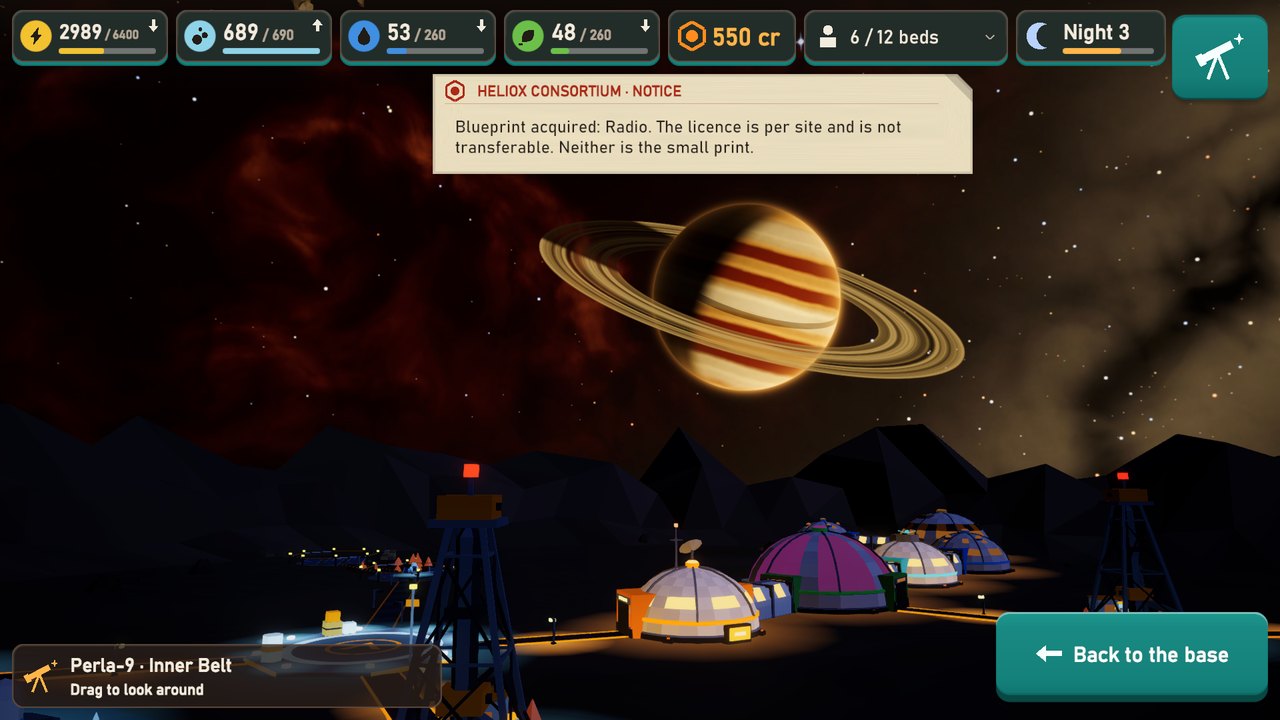
The camera over the base always looks down. The lookout is the other view: the spyglass key, top right, takes the camera down to the floor of the basin, behind the base, and raises its gaze over the rim of the crater.
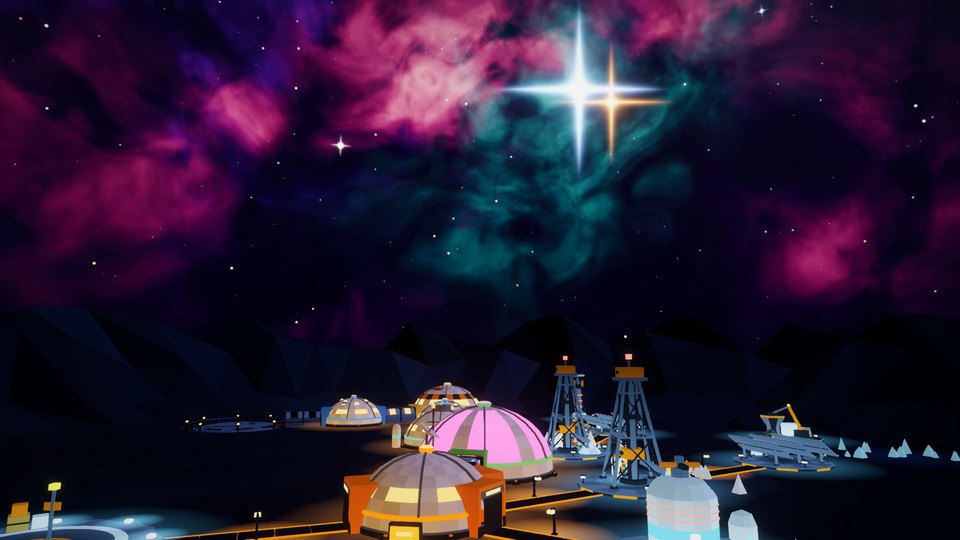
The Perla-9 lookout, at night
One finger turns your gaze: the sky stays under your finger, as the ground does over the base. The gaze has its stops: it reaches neither the zenith nor your own feet.
Nothing on the ground can be touched from there: no cards, no double tap.
You come back with Back to the base, with the same key, with Back, or by pinching two fingers together. You come back to the same spot at the same distance.
The camera travels, it does not cut: it takes 0.9 seconds to go down and the same to come back.
The game goes on running. The base's keys are put away, but the gauges and the alerts stay: tapping an alert, or a Company paper arriving, brings the camera back to the base.
Six sectors, six skies
Each sector has its own, with a lead that is the first thing you see on reaching the lookout. Within a sector, each asteroid sees it from a place of its own: a few degrees further round, larger or smaller.
Sector
What you see when you look up
Inner Belt
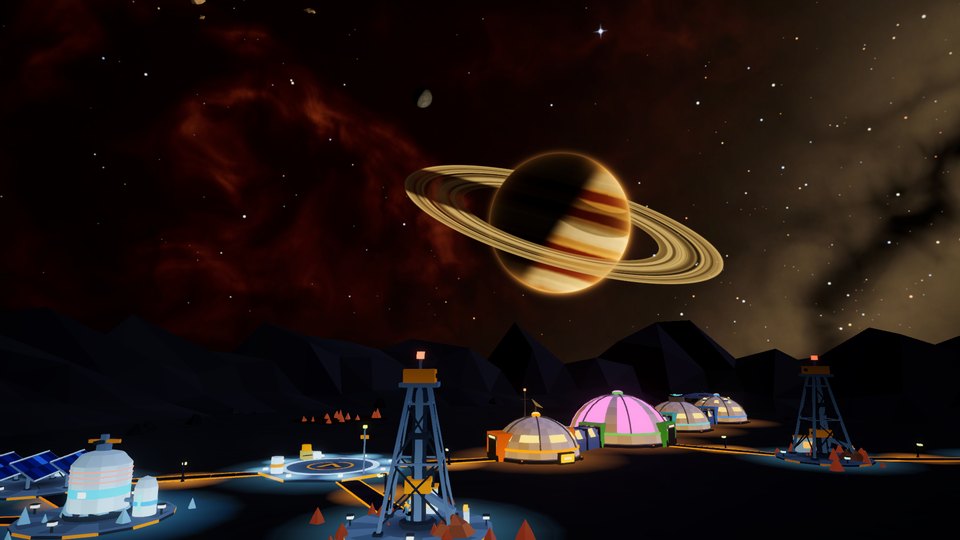
A gas giant with rings, bands and a storm, and its moon. The belt of rocks crosses the sky.
Sunward Reach
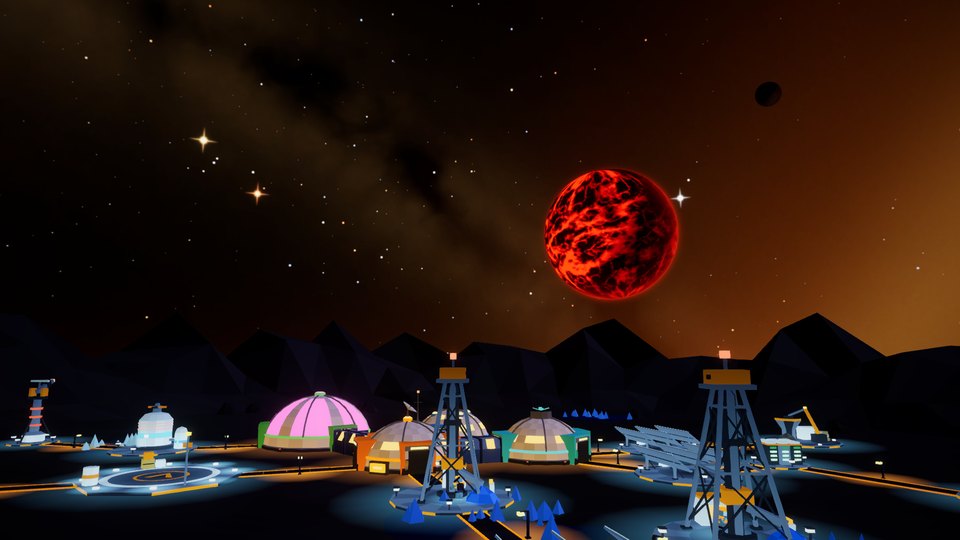
A sun twice the size it is anywhere else, and a world of lava glowing through its cracks.
The Rubble
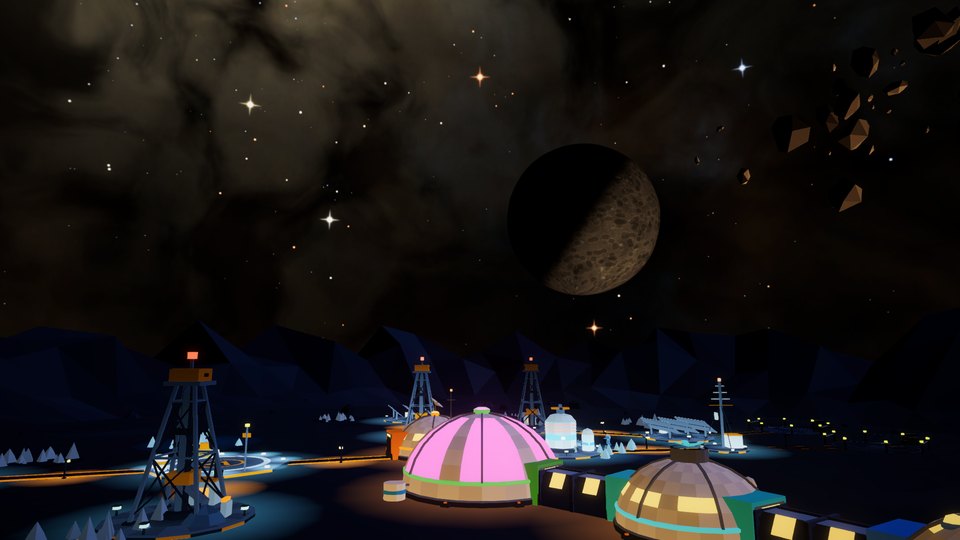
A broken moon, pitted with craters, with its rubble round it, and loose rocks all over the sky.
Regional Office
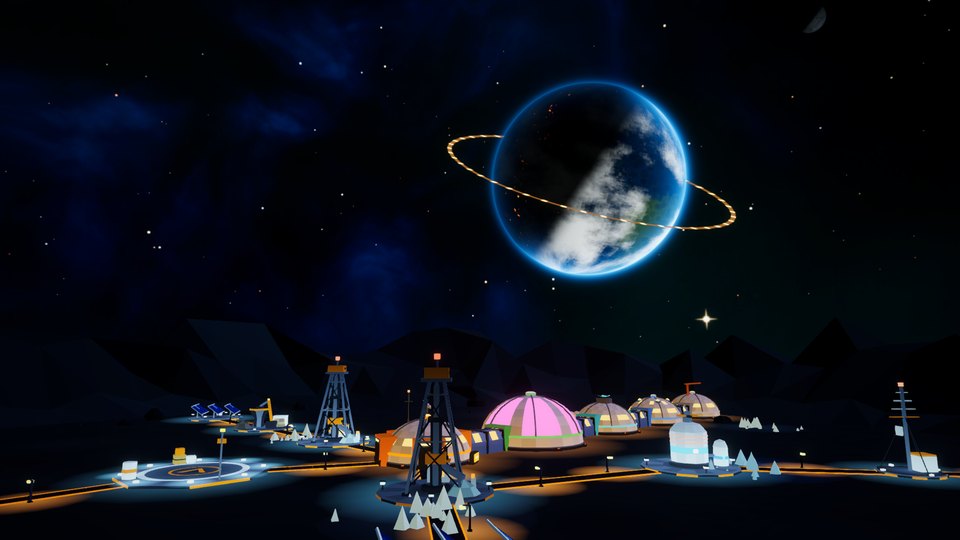
An inhabited world: seas, clouds, the lights of its cities on the night side and a ring being built.
The Long Haul
Two stars together, one blue and one amber, in front of a nebula. It is the fullest sky.
The Rim
An ice giant with a thin ring and almost nothing else: the galaxy is seen whole, from outside, behind you.
Inner BeltSunward Reach
The RubbleRegional Office
The Long HaulThe Rim
The sun is where the shadows say it is. By day it crosses the sky; as it sets it leaves its glow on the horizon.
The worlds have phases: that same sun lights them, and the phase changes through the day.
There is a sky by day too, fainter; at night it is all there.
14The Pad
Three things are done at the Pad: invoicing, requesting staff and asking for an advance.
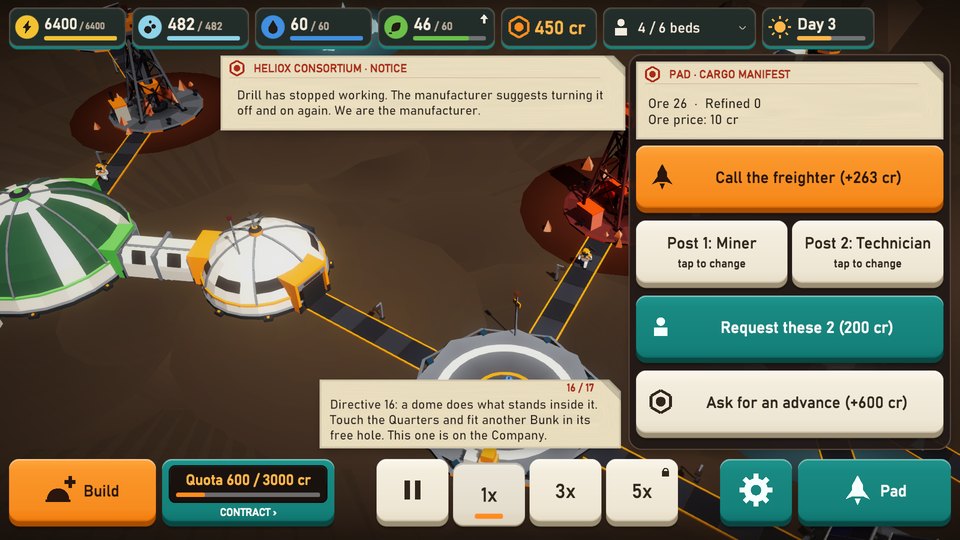
The Pad panel
Invoicing
Call the freighter says what it will pay. The freighter takes 1 minute to arrive, loads up to 60 t — refined metal first — and pays on take-off, at the price of that moment.
Only what is invoiced counts towards the quota.
The manifest says how much ore and refined metal are waiting and the price of ore. Refined metal is worth 2.5 times as much.
The Pad holds up to 120 ore and 60 refined; the Storehouse enlarges the reserves. With everything full, the drills stop: “Stopped: no room for what it makes”.
With a freighter on its way you cannot call another.
It is not the same everywhere
The freighter. The usual one loads 60 t and takes 1 min. Tarsis gets light shuttles, 30 t every 30 s; Ofir gets the heavy freighter, 120 t and 3 min away.
What is paid for. Not everything is bought alike: on Cipango unrefined ore is not bought and on Samarcanda it pays 50 %. Where that happens refined metal pays better, up to 4 times the ore, and everything ends up going through the Refinery.
The hiring freeze.Tetra-4 takes no more than four corponauts, and each passage costs 4 times the usual. With the staff at its limit the key says so: “This site's staff is at its limit”.
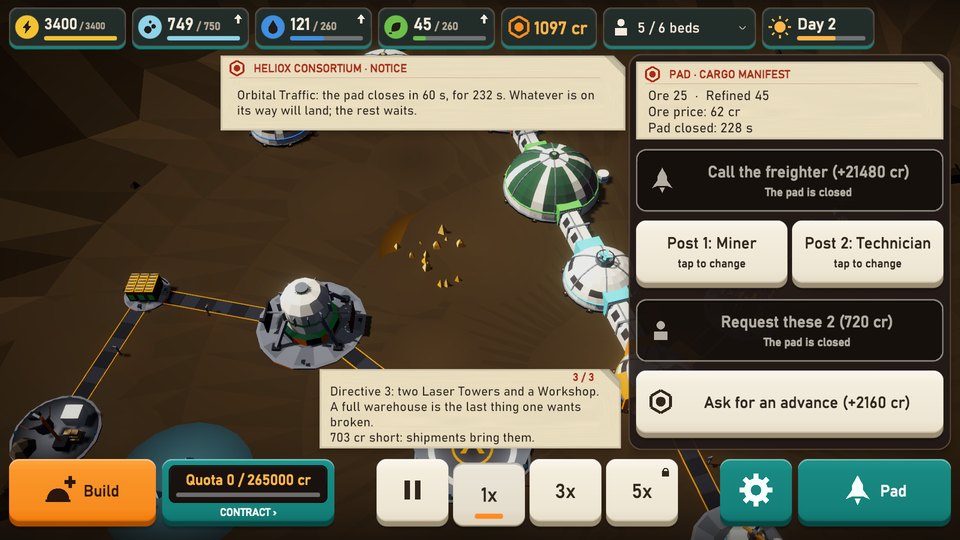
The pad closure. From Tarsis on, Orbital Traffic closes the pad now and then, for between 2 min 30 s and 4 min. While it lasts you cannot call the freighter or send for staff, and the manifest counts down what is left: “Pad closed: 228 s”. Whatever was already on its way lands, and pays (alerts and hazards).
Samarcanda: the pad, closed
Staff
Two posts, each with its trade (tap to change), and Request these 2 (200 cr). They arrive in 45 s. With no free beds they still arrive, but sleep on the floor (the corponauts).
The advance
Ask for an advance advances 600 cr, multiplied by the asteroid's carriage, and brings a rescue lot of 20 materials: what a Quarry and its walkway cost, with enough over for a part.
The Company takes back 1.5 times what it lent — 900 cr for those 600 — by keeping half of every shipment until it is settled. The freighter key says how much of that shipment goes to the debt.
No second one is granted while one is still owed, and with a debt the passage to the next asteroid is not sold: “First, what is owed to the Company”.
It is there for when the base runs out of money and has nothing to make any: no asteroid is ever left with no way out.
HELIOX CONSORTIUM · NOTICE
Advance granted, with a lot of approved aggregate. The amount will be deducted, with its surcharge, from a salary you technically do not receive.
15Alerts and hazards
There are ten. All of them warn you first, and all of them have an answer. The first seven turn up one by one in the first sector; the quake arrives on Grava-7, the stoppage on Insula and the pad closure on Tarsis.
For the first 8 minutes of a contract nothing happens.
One at a time: shower, flare, inspection, geyser, crack and quake never overlap. The market, breakdowns, stoppages and pad closures can.
Whatever is urgent calls with an alarm and turns the music tense while it lasts: the shower, the flare and the air leak each have their own; the geyser and the quake share the ground's. The shower and the geyser also mark on the ground where they will land. A breakdown and a vital running short call with theirs too, without changing the music. The phone says so in your hand: two thumps when an alarm starts.
The rest is news: the market, the inspection, the stoppage and the pad closure come with a notice and an alert, and no alarm.
The figures on this page are the usual ones. An asteroid may bring its own — more often, longer, more rocks — and its file says so.
The same contract brings the same hazards at the same moments: it can be learnt.
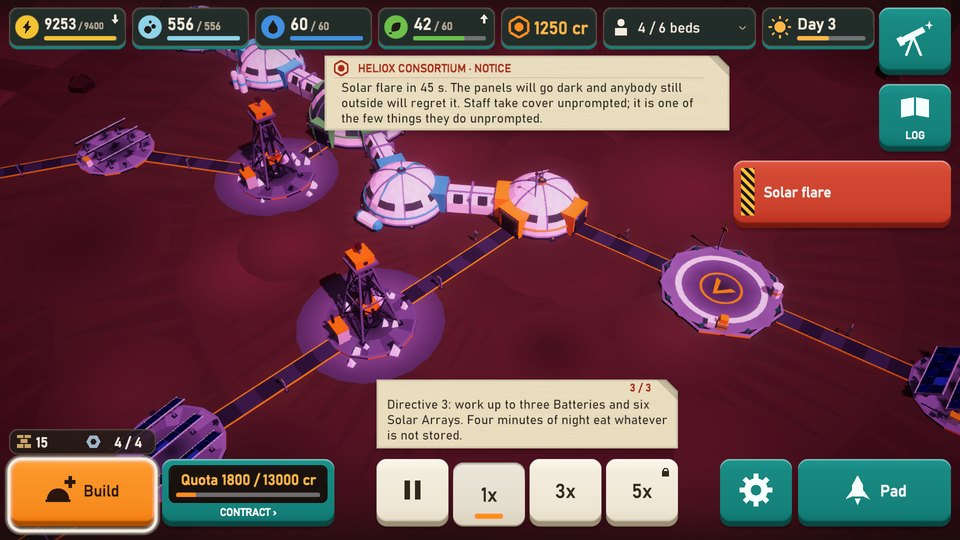
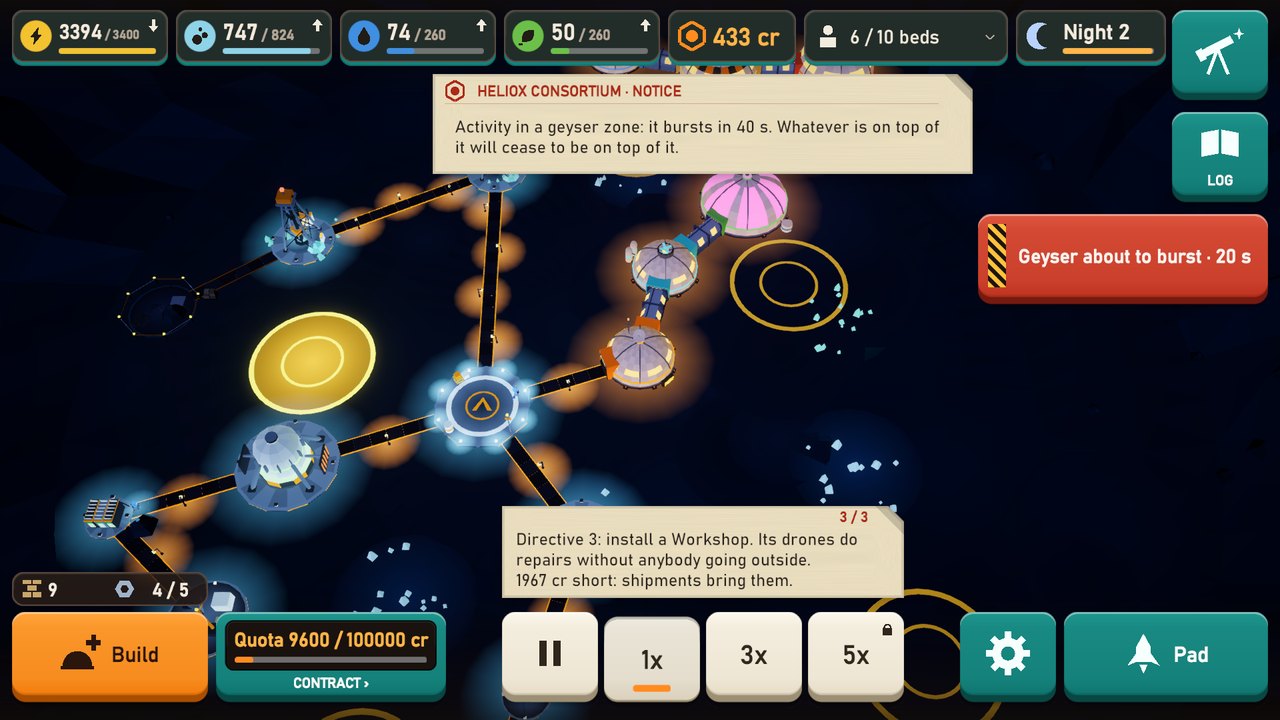
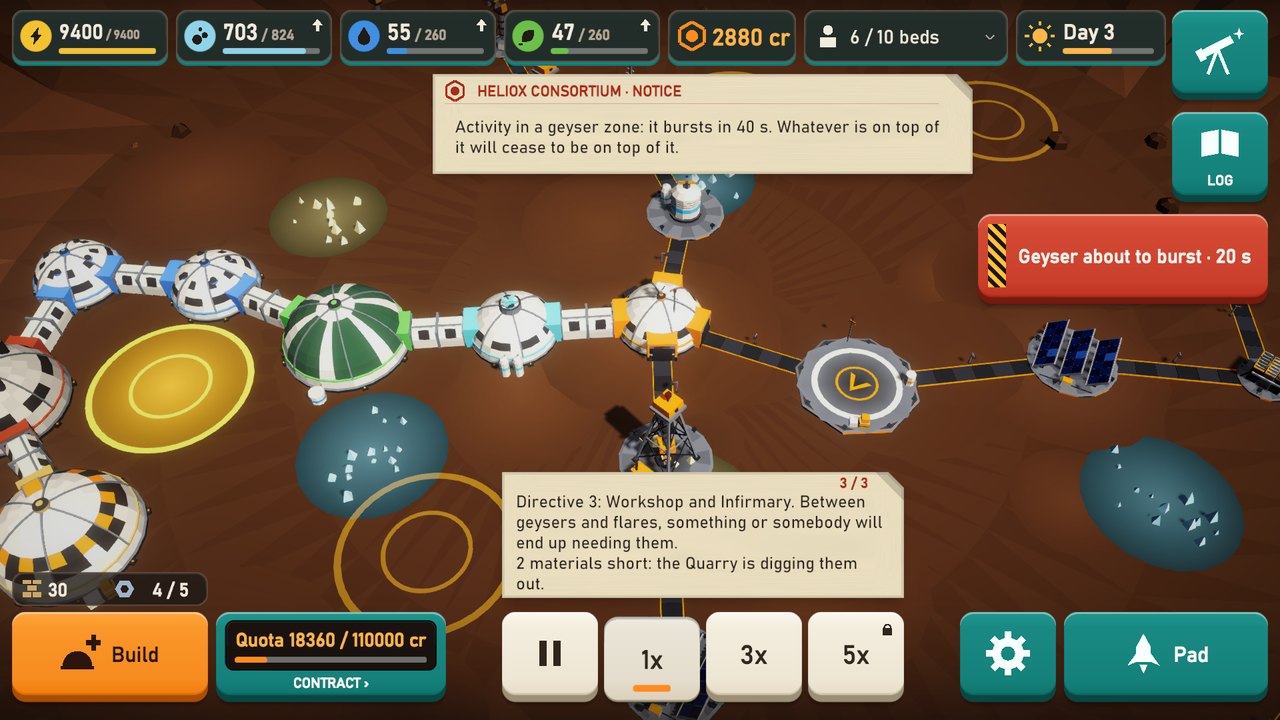
A meteor shower warning, on KrestaAn air leakA solar flare, on Baldur-3Erebo: the geyser zones, marked with circles
Breakdown
From
Perla-9
Warning
None: it does no harm
What happens
A structure you built stops producing and stops giving work. It still holds what it held, and people still sleep and eat in a dome. The Command Module and the Landing Pad never break down.
What to do
A technician repairs it in 20 s, and uses up a repair part. Or the Workshop's drones, in 30 s and with no technician, which use up another. With no part, it stays broken until one is made (parts and the Exchange).
Breakdowns: what breaks is mended by a technician. With none, it stays broken.
Meteor shower
From
Kresta
Warning
60 s ahead
What happens
4 to 7 rocks in 24 s, aimed at the base. One that lands on a structure breaks it and takes 35 health off anybody outside beside it. From the warning on, whoever is outside takes cover and nobody goes out: mining stops while it lasts.
What to do
A Laser Tower with power: it shoots down whatever falls within 28 m. Afterwards, repair what was hit.
Meteors: a minute's warning. Laser Towers shoot down what falls within their reach.
Air leak
From
Kresta
Warning
40 s ahead
What happens
A dome cracks: that is the crack, and its card counts down what is left. If nobody seals it in time it gives way, and the base loses 2.5 air a second through that breach until it is sealed. The dome keeps working while it leaks.
What to do
A technician, who leaves dinner and bed to go. Or the Workshop's drones. Sealing uses no part: air does not wait for something to be made.
Cracks: a cracked dome opens to the vacuum unless a technician gets there in time.
Market
From
Kresta
Warning
A notice, when it changes
What happens
Ore is worth 40 % more or 30 % less for a while: between 2 min and 3 min 20 s.
What to do
Call the freighter when it is up; wait when it is down. The Pad's manifest says whether the price is high or low.
Market: the price of ore goes up and down. A shipment is invoiced at the price of the moment.
Solar flare
From
Baldur-3
Warning
45 s ahead
What happens
1 minute with no panels. Anybody outside loses 3 health a second; the staff take cover unprompted.
What to do
Have batteries charged, or a Reactor.
Flares: no sun and no going out. Whoever is outside pays for it in health.
Inspection on its way
From
Baldur-3
Warning
120 s ahead
What happens
With the base in order, a bonus of 3 % of the quota; otherwise a fine of 3 %. “In order” means: nothing awaiting repair, no vital running short, a bed per person and average mood above 45. The fine never takes the account below zero, and neither bonus nor fine moves the quota.
What to do
Two minutes are enough to repair, charge batteries and add beds.
Inspections: a base in order earns a bonus; breakdowns, shortages or people without a bed, a fine.
Geyser about to burst
From
Erebo
Warning
40 s ahead
What happens
One of the 5 zones marked with circles bursts: whatever is on top of it breaks down. It hurts nobody. The zones are visible from the first second.
What to do
Do not build inside the circles; the game warns you when placing: “Warning: this is on a geyser zone”. And repair.
Geysers: the ground bursts inside the circles. Put nothing there that you want to keep.
The three that come later
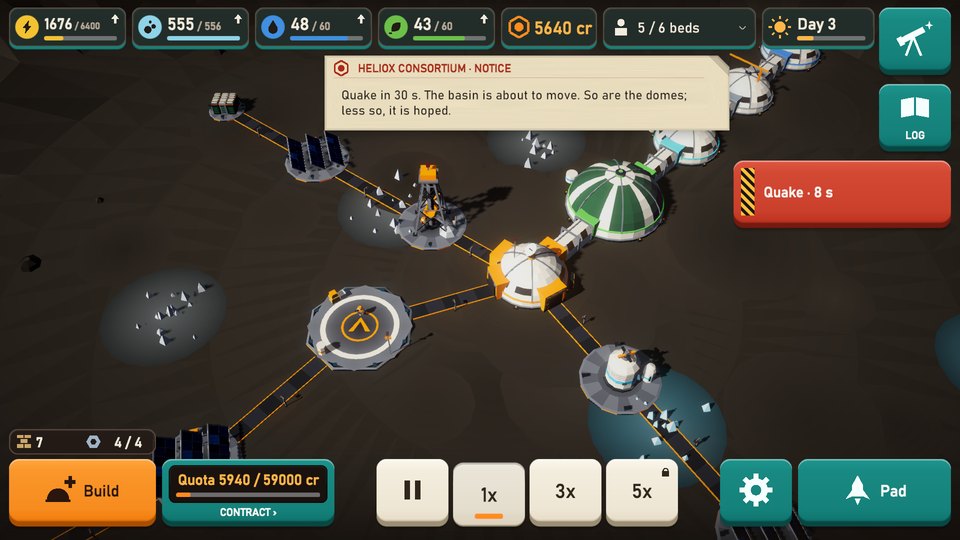
A quake warning, on TemblequeA stoppage called, on Acedia
Quake
From
Grava-7
Warning
30 s ahead
What happens
2 to 3 domes crack at once, and 1 to 2 structures outside break down. Each crack gives 40 s before it gives way, like any other. It has no place: the whole basin shakes.
What to do
A technician seals one crack at a time: with several at once it takes several technicians, or the Workshop's drones.
Quakes: half a minute's warning, and several domes crack at once. A technician seals one; a Workshop, all of them.
Staff stoppage
From
Insula
Warning
120 s ahead
What happens
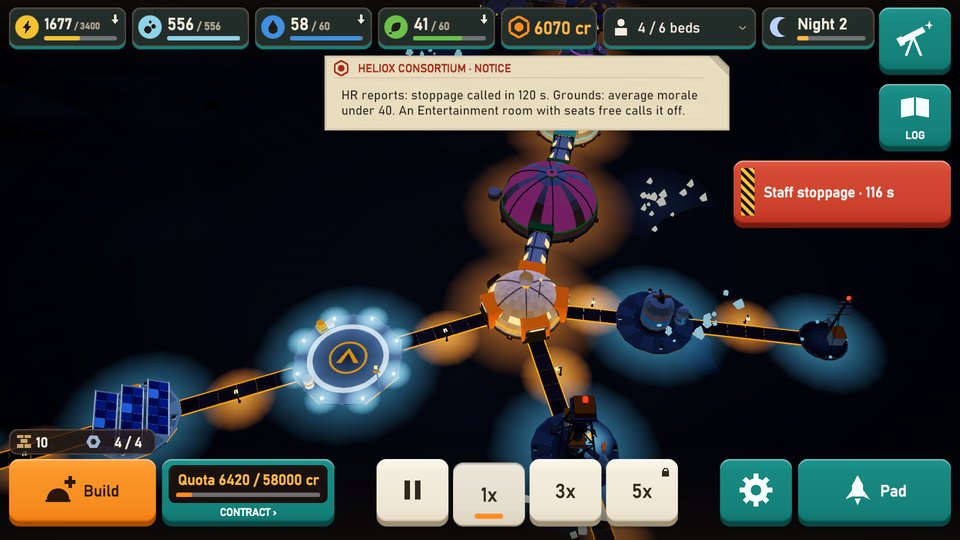
It is only called with average mood below 40. If it is still below when the warning runs out, 2 minutes with nobody working at anything that is not vital: air, water and food carry on. With mood back at 40, it is called off.
What to do
A Entertainment room with room in it, before the warning runs out.
Stoppages: with average morale under 40 the staff call a stoppage. An Entertainment room heads it off, even at the last minute.
Pad closure
From
Tarsis
Warning
60 s ahead
What happens
Between 2 min 30 s and 4 min with no way to call the freighter or send for staff. Whatever was already on its way lands, and pays.
What to do
Ship before it closes, and have a Storehouse for what piles up meanwhile.
Pad closures: a minute's warning. While they last nothing is sent for: no freighter, no staff. Store, or ship beforehand.
Shortage alerts
The alert says
What to do
“Something vital has lost power”
This is a power cut, the kind some commissions ask you to avoid. More batteries and more panels, or a Reactor.
“The batteries are running down”
The vital things are about to empty the batteries. More batteries before the next night.
“Air is running out”
Another Life Support, and make sure it is not short of water or power.
“Water is running out”
An Ice Extractor on ice that still has reserves, or a Recycler.
“Food is running out”
Another Greenhouse, or a biologist in the one you have; or a lot of food at the Exchange.
The alerts of the works
The alert says
What to do
“A repair part is needed”
Something has broken down and there is no part in store. The bench orders one by itself if there are materials, and the technician makes it before any site. With a Radio, you can buy one.
“Works stopped: no technician”
There is something to raise — a site, a module or a link — and no technician on the staff. Send for one at the Pad; with no money, the advance.
16Quota, stars and ranks
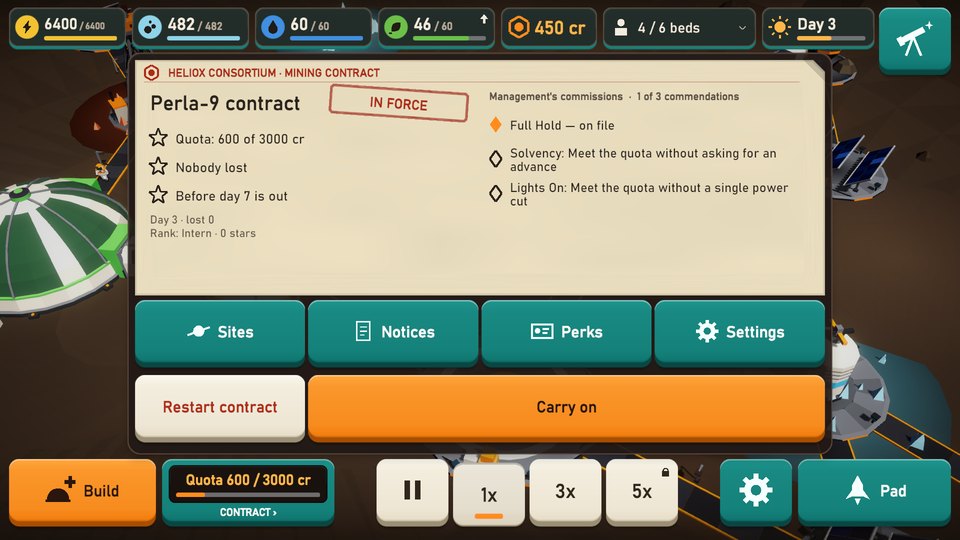
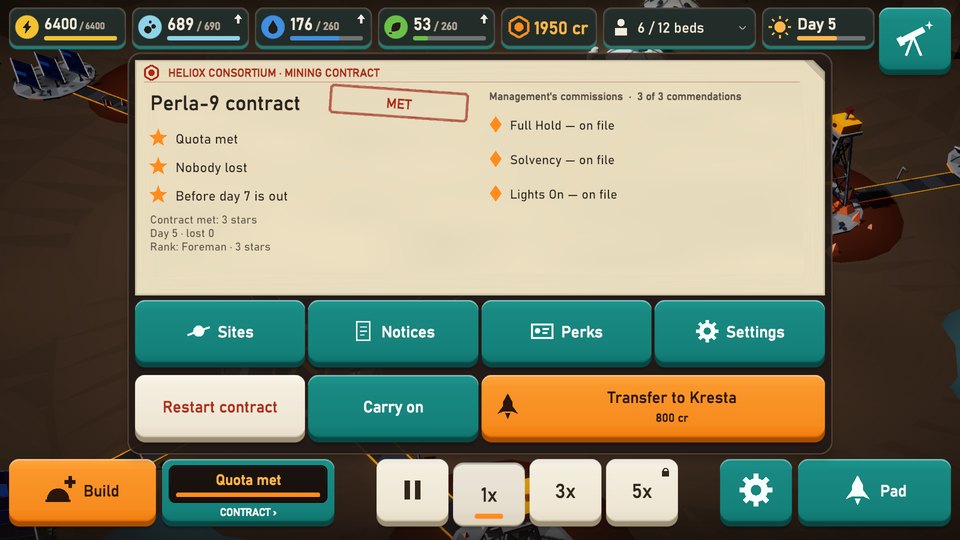
The quota is invoicing: what the Company has collected for your shipments. It only goes up, and there is no countdown. The quota key opens the contract: how each star stands, the day, losses, debt and rank; on the right, the three commissions.
The contract, in forceThe contract, met
The three stars
Meet the quota.
Lose nobody.
Before the day the asteroid sets is out: day 7 on Perla-9.
They are judged on the day the quota is met: a later loss does not take away a star already earned. The contract shows how each stands with three shapes, not three colours: a full star, earned; hollow, still possible; a cross, lost, and why (“Nobody lost — 1 have been”).
Ranks
Stars give you rank, and rank opens the catalogue: it says which blueprints are offered. Holding them is a matter of each contract's money, except for those that come with it.
Rank
Stars
Unlocks
Intern
0
Solar Array, Battery, Quarry, Ice Extractor, Life Support, Quarters, Greenhouse, Drill, Storehouse and Radio
Foreman
1
Canteen, Refinery, Recycler, Infirmary and Laser Tower
Supervisor
4
Entertainment room and Workshop
Site Director
8
Reactor
Vice-President of Extraction
12
Nothing: it is a title.
Senior Vice-President of Extraction
18
Nothing: it is a title.
Executive Vice-President
30
Nothing: it is a title.
Divisional Managing Director
44
Nothing: it is a title.
Board Member
58
Nothing: it is a title.
Chief Executive
72
Nothing: it is a title.
Shareholder
90
Nothing: there is no higher.
The seven ranks above Site Director are titles: they unlock nothing, because by then the catalogue is complete. They give the name the menu and the map of sites call you by, and a line from the Company. The last, Shareholder, asks for all 90 stars: three on each of the thirty asteroids.
The best result on each asteroid is what counts: losing a contract or repeating it takes nothing away. Rank is also granted on arrival: Kresta and Baldur-3 give at least Foreman; Nix Profunda and Erebo give at least Site Director. From the second sector on, each sector gives at least its own: Sunward Reach, Vice-President of Extraction; The Rubble, Senior Vice-President of Extraction; Regional Office, Executive Vice-President; The Long Haul, Divisional Managing Director; The Rim, Board Member. Stars bring promotion forward; nobody goes without it.
Management's commissions
Three per asteroid, 90 in all (they are listed under the 30 asteroids). Fulfilling them earns a commendation on file. Nothing else. No credits, no stars, no rank. Those that ask for something not to have happened — no advance, not one power cut — are judged when the quota is met.
Once the quota is met
The contract offers Transfer to Kresta · 800 cr: it pays the passage and takes you there, in one tap. Or you can stay.
The passage is paid from this asteroid's account: money does not travel, people do. With a debt it is not sold.
Each asteroid keeps its own game, and you can go back to any one already open without paying: on the contract, Sites.
Restart contract throws away the whole colony and starts the asteroid again. It asks for two taps.
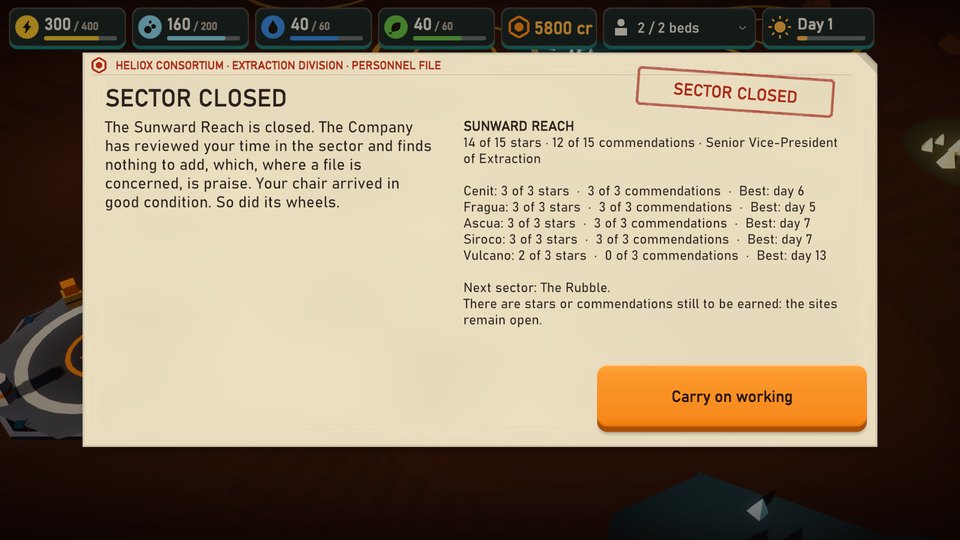
With the quota of a sector's last asteroid met, the Company closes the sector with its tally: stars, commendations, rank and the best day on each site. The last sector's closing is the career's, with a line to each sector. The sites stay open for whatever is still missing.
A sector's closing letter
HELIOX CONSORTIUM · NOTICE
Congratulations. Management has decided to reward your effort with more effort. See your next contract.
17The thirty asteroids
A career of thirty contracts in six sectors of five, from Perla-9 to Finisterre. Each asteroid has its ore, its day and its night, its quota and something of its own: a hazard no earlier asteroid had, or site conditions that its file states before you sign — how much the sun gives, which freighter comes, what is not delivered there, what base the last person left. Carriage multiplies every price in credits — blueprints, staff, upkeep, the advance and the Exchange — relative to Perla-9. Off that road there are nine more contracts: six singular ones, on another kind of ground, and three tenders against another corporation.
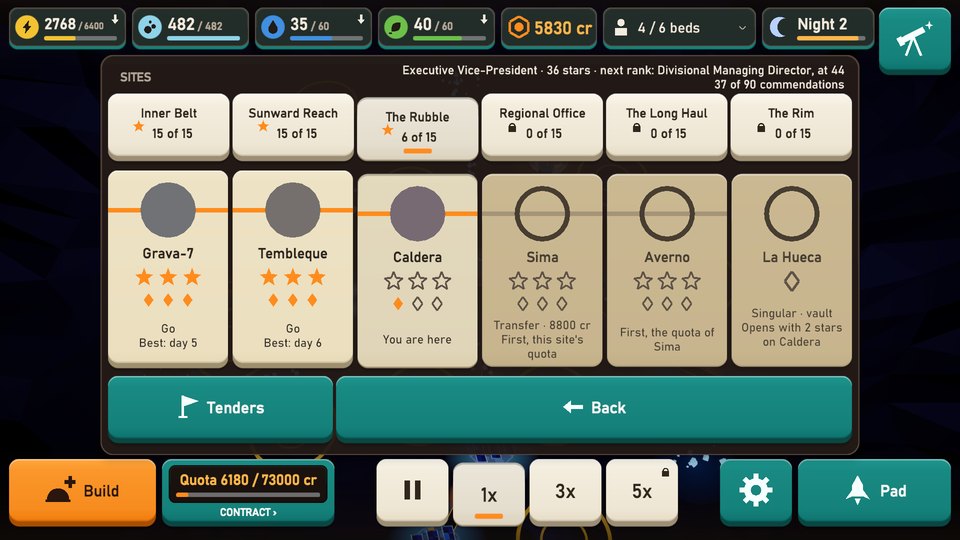
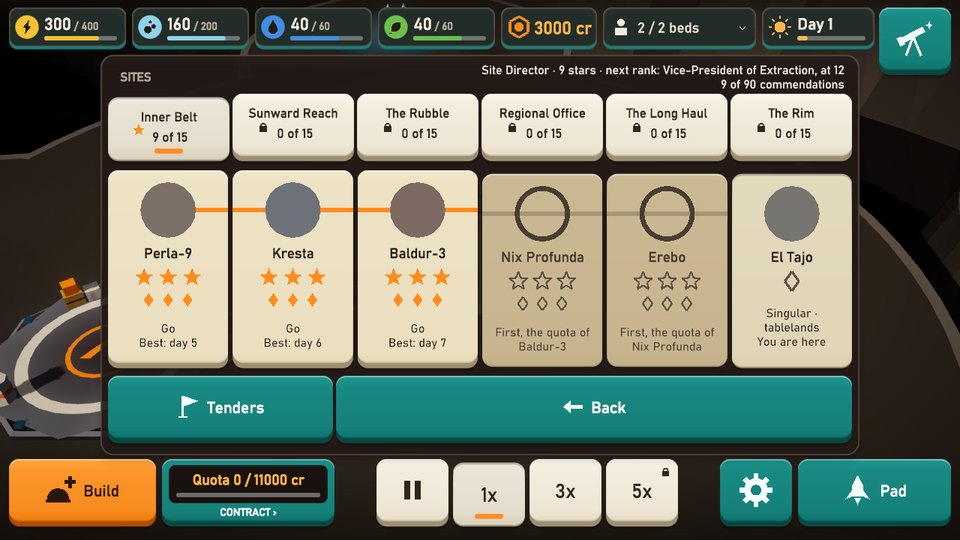
The map of sites: six sectors of five, and a singular contract in each
On the map of sites — on the contract, Sites — there is a key for each sector, with its stars; a padlock says you have not got there yet. Below, the sector's five asteroids in a row: those you have worked, with their stars, commendations and best day; the next one, with what the passage costs. You can go back to any one already open without paying.
Each sector is about one thing and closes with its last asteroid, which brings together what the other four had. Quotas run from 3,000 to 540,000 cr. Each asteroid starts with its own capital and from scratch — or from what the last person left: what you carry from one to the next is your rank and what you have learnt.
The Ascua file: the site conditionsFragua, on arrival: the base the last person left
Where the trade is learnt: the hazards arrive one at a time, and rank opens the catalogue as you go. From Perla-9 to Erebo, with quotas from 3,000 to 100,000 cr.
Curia. Six staff, inspectors and a collective agreement. Sector management is looking out of the window. Wave.
Ore
Tantalum, at 169 cr a tonne
Day and night
5 min of day and 3.3 of night
Quota
200,000 cr
Credits on arrival
13,500 cr
Founding lot
190 materials and 2 parts
Carriage
×3.4
Third star
Before day 10 is out
Deposits
3 ore seams and 3 ice sheets
Rank on arrival
Executive Vice-President, at least
Passage onward
24,000 cr, to Tarsis
Site conditions
An unpopular posting: staff morale settles lower.
Inspections: at 2.6 times the usual rate.
Stoppages: at 1.3 times the usual rate.
Directives
Reactor, Drill, ice, air, food and Quarters. There are six of them from the first day.
Entertainment room and Workshop. The first for the agreement; the second for the inspector.
Refinery and Canteen. Management values results. The staff, the menu.
Management's commissions
In Full View of the Office. Inspections with a bonus: 6
Agreement in Force. Meet the quota without a single stoppage
Full Organisation Chart. Corponauts at once: 12
Sector 5: The Long Haul
The freighter and the market: here the hard part is not getting the ore out of the ground but getting it out of here. From Tarsis to Samarcanda, with quotas from 46,000 to 265,000 cr.
Finisterre. All of the above, at once. The Company has no further advice. It has a quota.
Ore
Neutronium, at 268 cr a tonne
Day and night
2 min of day and 8 of night
Quota
540,000 cr
Credits on arrival
22,000 cr
Founding lot
190 materials and 2 parts
Carriage
×4.5
Third star
Before day 10 is out
Deposits
5 ore seams and 3 ice sheets
Rank on arrival
Board Member, at least
Passage onward
There are no more sites
Site conditions
Sun: Solar Arrays give 50% of their output.
Porous rock: air leaks 1.5 times as fast.
An unpopular posting: staff morale settles lower.
Freighter: a 90 t hold, 120 s away.
A rich seam: it yields 150%.
Directives
Reactor and the usual, outside the circles. It is the last time you will be told.
Entertainment room, two Laser Towers and Workshop. The people, the sky and the ground, in that order.
A second Reactor and two Refineries. Finisterre's quota is not met with a small base.
Management's commissions
The Shipment of the Catalogue. A single shipment of 35,000 cr
The Dozen. Corponauts at once: 12
Ready for Judgement. Inspections with a bonus: 3
18The reliefs and the singular contracts
Not every asteroid is a flat basin. There are three kinds of ground, and the ground changes where you may build and how you get from one place to another. The thirty of the career are basins; the other two are played on six singular contracts.
Tablelands
El Desfiladero: tablelands, chasms and bridgesA bridge over a chasm
The ground is tablelands separated by chasms. You only build on a tableland: its edge carries a pale line and, off it, the ghost says “Off the tableland”.
The link that crosses a chasm is a bridge: up to 32 m, at three times the materials of a walkway, and never a corridor. The strip says so as you place it: “It crosses a drop: whoever walks it is out in the open.”
A bridge is crossed in the open. With a shower or a flare nobody crosses: whatever is on the far side waits.
The ore, the ice and the base tend to be on different tablelands: here the base does not grow, it is shared out.
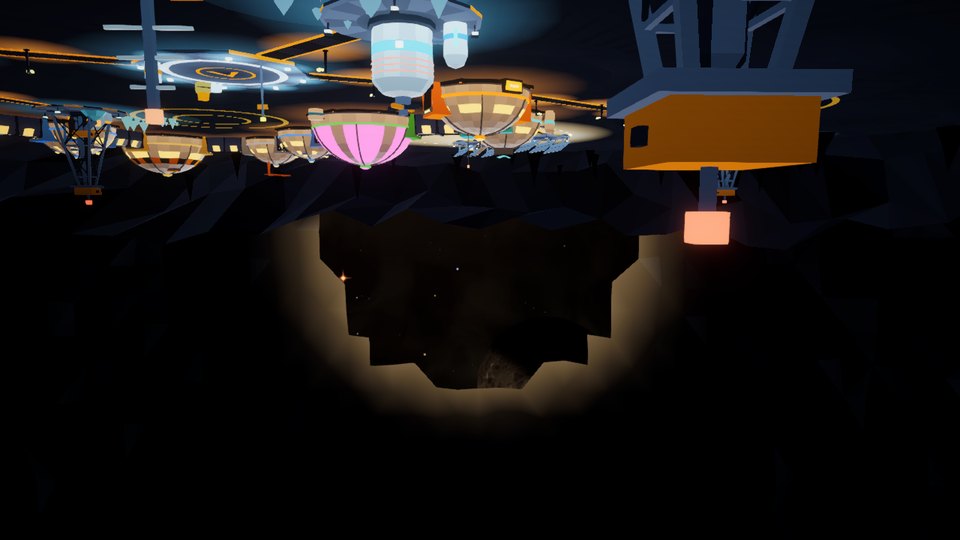
The vault
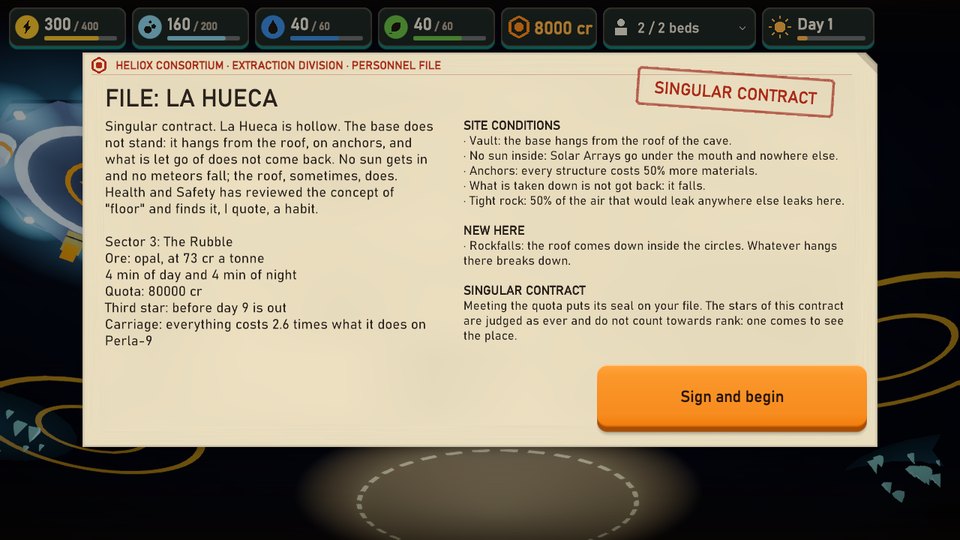
La Hueca: the base, hung from the roofThe mouth of the vault, from the lookout
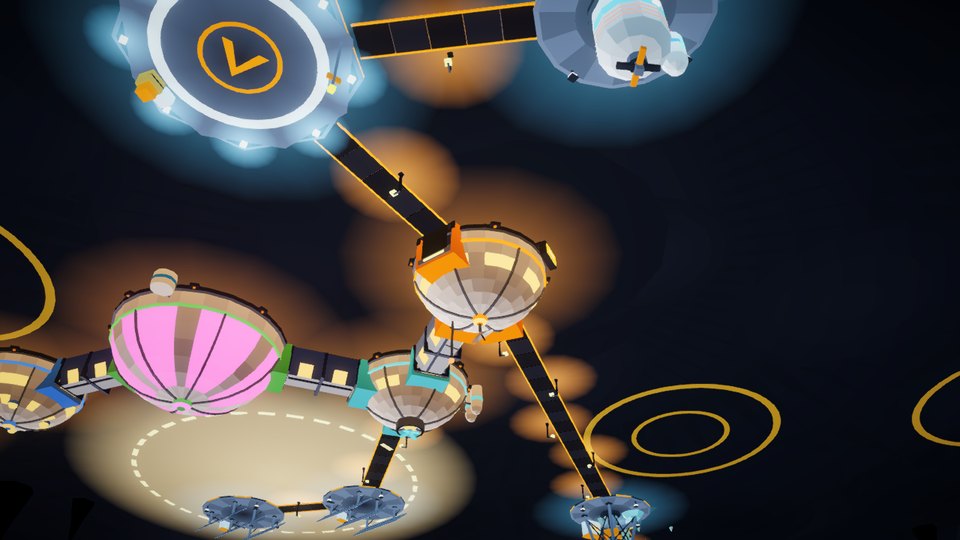
The base hangs from the roof of a cavern. The camera turns the picture over, and your finger with it: it handles the same.
No sun gets inside: the Solar Array only goes up under the mouth, which is where it comes in. Away from it, the ghost says “Solar Arrays only work under the mouth”. The answer is a Reactor.
Everything takes anchors: every structure costs 50 % more in materials. And what is demolished is not recovered: it falls.
No meteors fall. Its own hazard is the rockfall: the roof comes down inside circles that are visible from the first second, and whatever hangs there breaks down.
The six singular contracts
A singular contract on its sector's mapThe La Hueca file
There is one to a sector, at the end of its sector's map and off the road. It opens with two stars on the sector's third asteroid, and costs no passage. It gives a seal on your file, not stars towards rank, and it has no commissions: Meeting the quota puts its seal on your file. The stars of this contract are judged as ever and do not count towards rank: one comes to see the place.
El Tajo. Three tablelands and two drops. What is yours is on this side; the ore, on the other. Put the Drill on its seam: the link crosses by itself, and it is a bridge.
Relief
Tablelands
Sector
Inner Belt
It opens
With two stars on Baldur-3
Ore
Magnesium, at 24 cr a tonne
Day and night
4.7 min of day and 3 of night
Quota
11,000 cr
Founding lot
160 materials and 2 parts
Third star
Before day 7 is out
Directives
What it takes to live, on this side: Solar Array, Ice Extractor, Greenhouse and Life Support. Things are built on a tableland and nowhere else.
A Drill on the seam across the drop. Its link crosses it: that is a bridge. It costs three times a walkway and is never longer than 32 metres.
A second Drill and a Laser Tower. What falls into a chasm does not fall on you.
El Sótano. The great vault. It shakes, it sheds and it is far away. Two technicians from the first day: you will use them.
Relief
Vault
Sector
The Rim
It opens
With two stars on Tule
Ore
Tritium, at 83 cr a tonne
Day and night
2.5 min of day and 7.5 of night
Quota
160,000 cr
Founding lot
300 materials and 3 parts
Third star
Before day 9 is out
Directives
Reactor and Drill. Outside the circles, of which there are seven here.
Ice, air and food.
A Workshop and a second Reactor. Between the quakes and the rockfalls, everything here breaks twice.
19The tenders
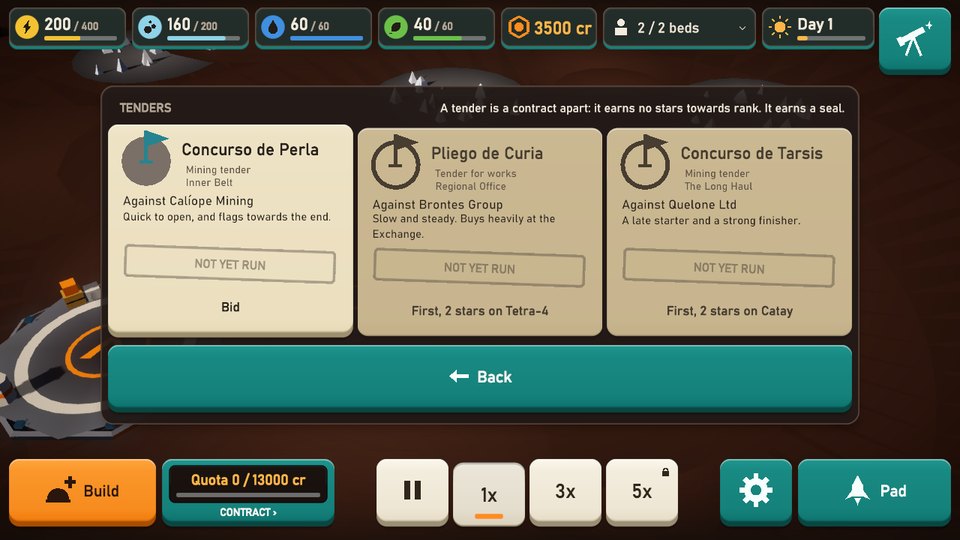
A tender is a contract apart from the thirty: the same asteroid, and another corporation working it at the same time, in plain sight, on its concession at the rim of the basin. You get there with the Tenders key on the map of sites.
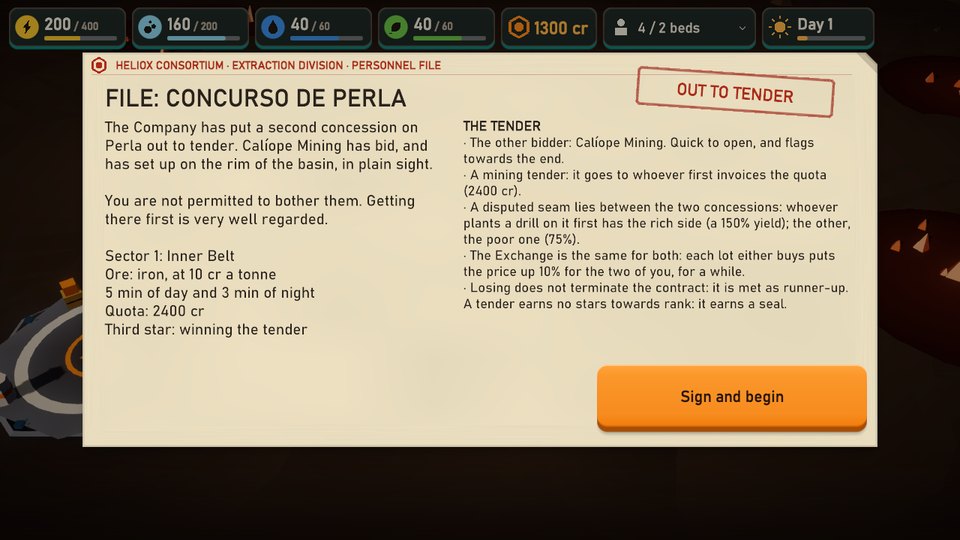
The list of tendersA tender's file
Tender
Kind
The other bidder
It opens
Concurso de Perla
Mining tender
Calíope Mining. Quick to open, and flags towards the end.
First, 2 stars on Baldur-3
Pliego de Curia
Tender for works
Brontes Group. Slow and steady. Buys heavily at the Exchange.
First, 2 stars on Tetra-4
Concurso de Tarsis
Mining tender
Quelone Ltd. A late starter and a strong finisher.
First, 2 stars on Catay
How it is won
Mining: it goes to whoever invoices the quota first. Works: to whoever first has the schedule standing and in service — the list of structures it asks for.
Winning is the third star. Losing does not terminate the contract: it is met as runner-up. A tender earns no stars towards rank: it earns a seal.
The rival is not a scoreboard: it is a real game, played by the same rules. The same race is the same every time: it can be learnt.
Where the two rub
The race plate and the notice about the rivalThe disputed seam
The disputed seam, between the two concessions: whoever plants a drill on it first keeps the rich side (it gives 150 %); the other, the poor one (75 %). The ring round the seam carries the colour of whoever holds it.
The Exchange is the same for both: each lot one of you buys puts the price up 10 % for both, for a while.
The exclusive blueprint, in a tender for works: whoever first buys the blueprint the file names makes it 50 % dearer for the other.
What you see of the race
The other concession, from the lookoutThe record of a tender won
The race plate, under the gauges: who is ahead, how far each has got and the last thing the rival did.
The Company's notices about the rival — its shipment, its purchase at the Exchange, the seam — which are kept in the mission log as well.
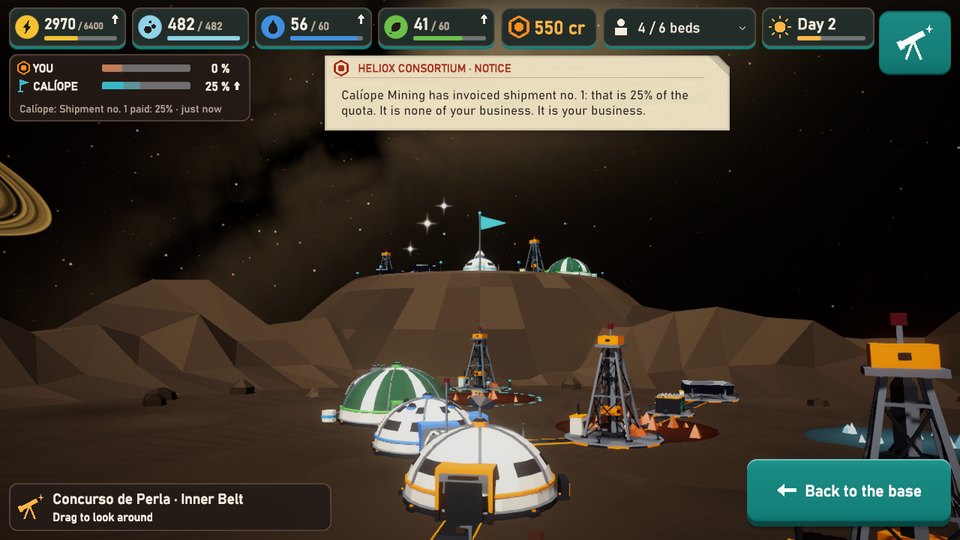
The other concession, on the rim of the basin: you see it from the lookout, with its pennant, and at night, with its lights. Its plot beside the seam is not yours to build on: “That plot is the other bidder's”.
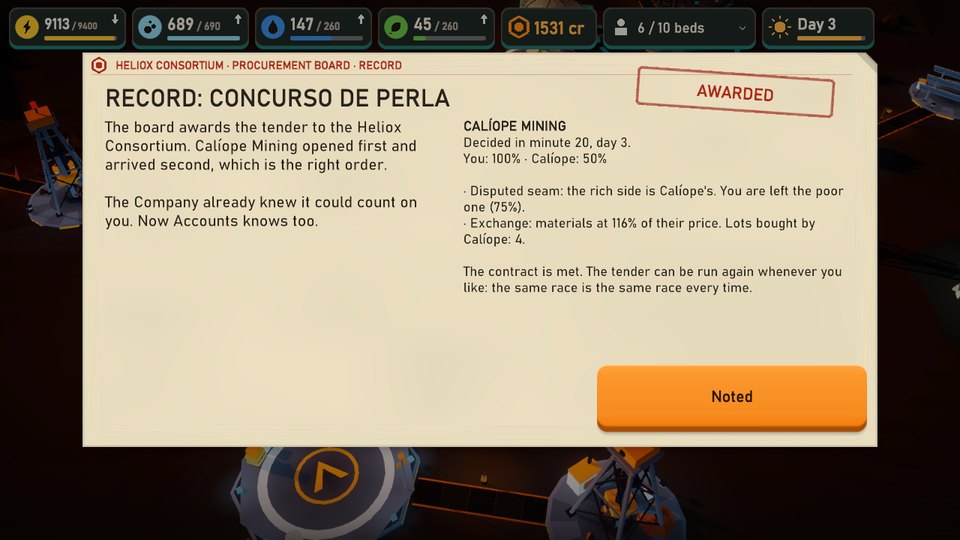
The record, when it is decided: who takes it, in which minute, and how each stood. The list of tenders keeps the seal and the best time.
HELIOX CONSORTIUM · NOTICE
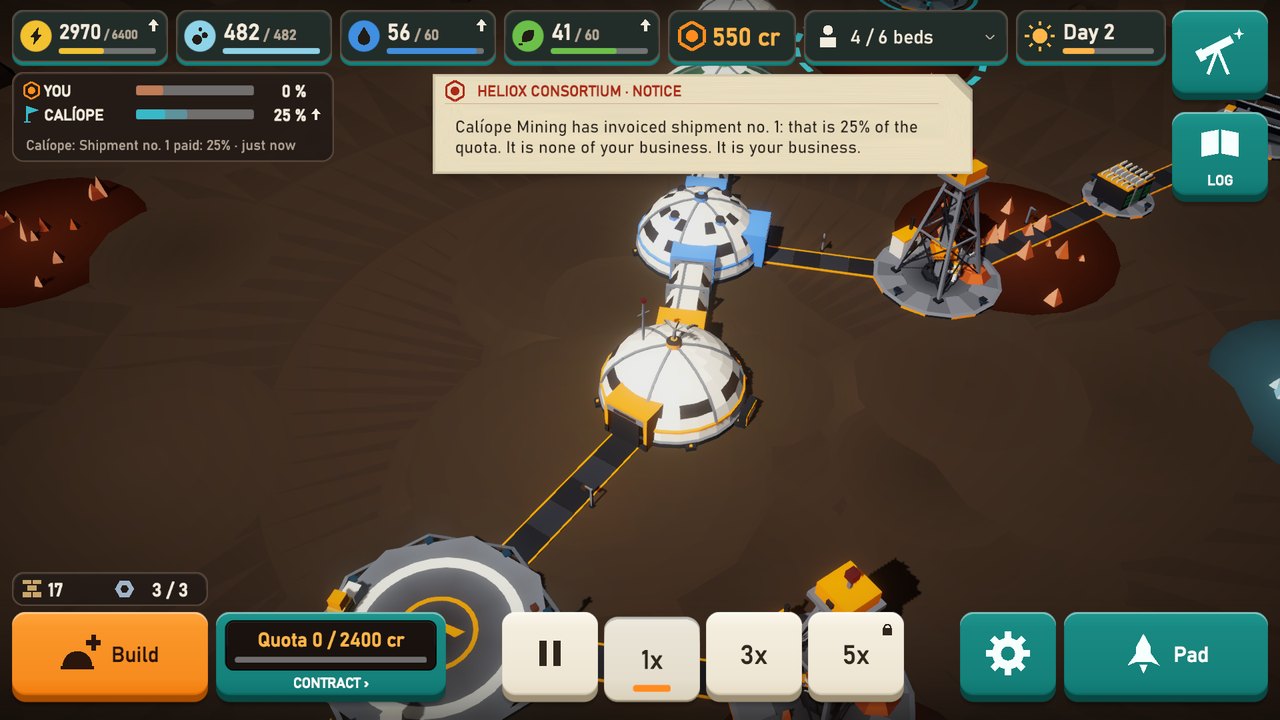
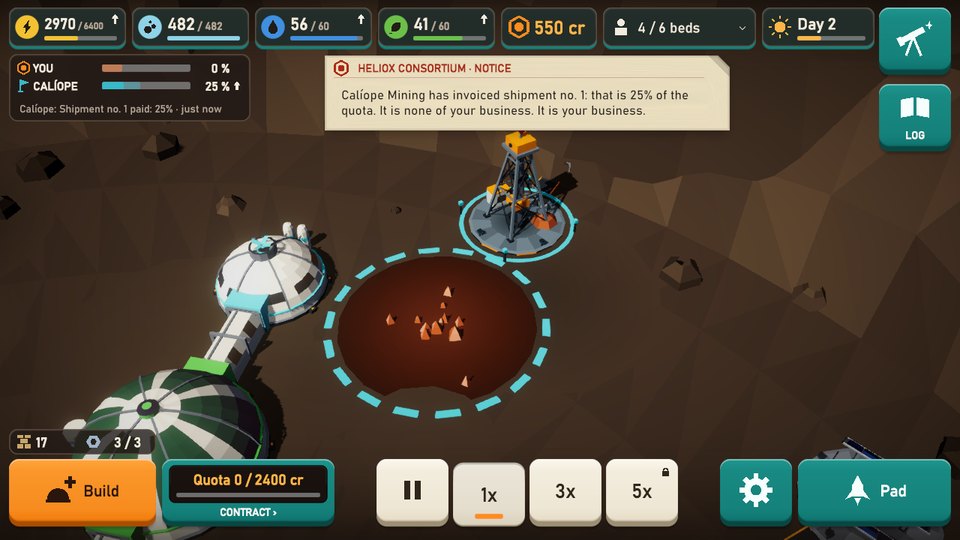
Calíope Mining has invoiced shipment no. 1: that is 25% of the quota. It is none of your business. It is your business.
20Pause, speeds and saving
Paused
Bottom centre: pause, 1x and 3x. The one in force stays pressed in, with an orange pilot light on.
You can build and plan while paused. The day gauge says so too: “Paused”.
5x has a padlock. It belongs to the Supervisor Pass, and in this version it cannot be had: the Perks panel reads “The shop is not available in this version”.
Going faster gives no advantage: the deadline for the third star is counted in asteroid days, not minutes on the clock.
While there is a Company paper to read, the clock waits.
Saving
The game saves by itself every 60 seconds, when it goes to the background — which also pauses it — and when it closes. You never have to remember to save.
When you come back it carries on at the speed it had, unless you were the one who paused it.
With the app closed nothing happens: there is no progress without you there.
Each asteroid keeps its own saved game, inside its file.
Save and exit — on the game's settings panel — saves and returns to the main menu; from there you continue, load another file or quit (opening the game).
With the menu up the clock does not run and nothing is written: the colony is already still and already saved.
21Settings, sound and vibration
They open with the cog, next to the Pad; from the contract, with Settings; and from the main menu. There are six keys, and each tap moves to the next value. They apply and are saved at once, and they belong to the installation, not to one game or one file.
Settings, inside a game
Setting
Values
What it does
Language
The phone's · Español · English
“The phone's” is Spanish if the phone is set to Spanish (or Catalan or Basque), and English for everybody else.
Text size
Small · Normal · Large
Three sizes (×0.85 · ×1 · ×1.2). No text is ever cut off: one that does not fit its box is drawn a little smaller.
Sound
Loud · Quiet · Off
The volume of everything: keys, notices, alarms, the background and the music too. “Off” silences it all.
Music
Loud · Quiet · Off
The music alone, for anybody who wants the effects without it or has their own playing. Alarms and notices are still heard.
Vibration
On · Off
The phone's taps in your hand. It also follows the phone's own “touch feedback” switch: turn that off there and you will not have it here.
Graphics
Full · Light (if it stutters)
Light removes the glow, wide-range colour, soft shadow edges and anti-aliasing. Nothing that tells the player something disappears, and at night the structures light up just the same.
Inside a game, under the settings is Save and exit (opening the game). At the top, the panel gives the game's version (“Corponaut 1.1.0”).
What you hear
The music is not a loop. On the menu the Company's theme plays. In a game one whole piece plays — there are three — and then a silence of between 40 and 80 seconds, with the air of the base behind it.
It changes with the sun. Each piece has a day mix and a night mix, and moves from one to the other as night falls or day breaks, with no cuts.
It turns tense while there is a hazard with an hour — shower, flare, geyser, quake — or an air leak, and drops under an alarm, to let it be heard.
The alarms do not sound alike: the one for air, for the shower, for the flare, for a vital running short, for the ground and for a breakdown can be told apart without looking. A quota met, a promotion and a contract lost each have a phrase of their own, and the closing letters, their piece.
What you feel
What happens
What you feel in your hand
A key
A tick, the lightest there is.
The game says yes, or no
The phone's own “yes” or “no”, instead of the tick.
A module assembled · a shipment paid
A click and a tick · a tick and a click.
An alarm starting
Two firm thumps, once only.
A meteor landing · shot down by a tower
A firm thump · a tick.
Somebody lost
Three thumps, slow.
Quota met · a promotion
Two ticks and the “yes” · two clicks and the “yes”.
It is never a buzz and it is rationed: a shower of ten rocks is a few thumps, not a rattle. The game asks for no permission for this, so every phone gives these taps in its own way.
22Why it has stopped
Tap the structure: its card says so in these words.
The card says
What is going on, and what to do
“A site: a technician raises it”
It is a site: a technician raises it, one at a time and in order. Its card says how far along it is; if there is no technician at all, send for one at the Pad.
“Broken: needs a technician and a part”
A free technician goes unprompted, takes 20 s and uses up a part. With no part, he makes one at the bench first; with no technician it stays broken: send for one at the Pad, or raise a Workshop.
“Stopped: nobody at the post”
Nobody of that trade is free, or they are eating, sleeping or taking cover. More staff, and beds for them.
“Stopped: the deposit is spent”
Demolish it (you get half back) and put up another on a deposit that still has reserves.
“Stopped: short of supplies”
It is short of what it uses: water for Life Support or the Greenhouse, ore for the Refinery.
“Stopped: no room for what it makes”
Call the freighter, or put up a Storehouse.
“No power”
More solar arrays and more batteries; or a Reactor.
“Standing by: the batteries are keeping the vital reserve”
Normal at night with few batteries: it comes back by itself at dawn. To avoid it, more batteries.
“On stoppage”
There is a staff stoppage: nobody works at anything that is not vital until it ends, or until mood is back at 40. A Entertainment room with room in it (alerts and hazards).
HELIOX CONSORTIUM · NOTICE
Breakdown: Drill. Send a technician. If you have no technician, consider having one.
 Corponaut